
The Wire
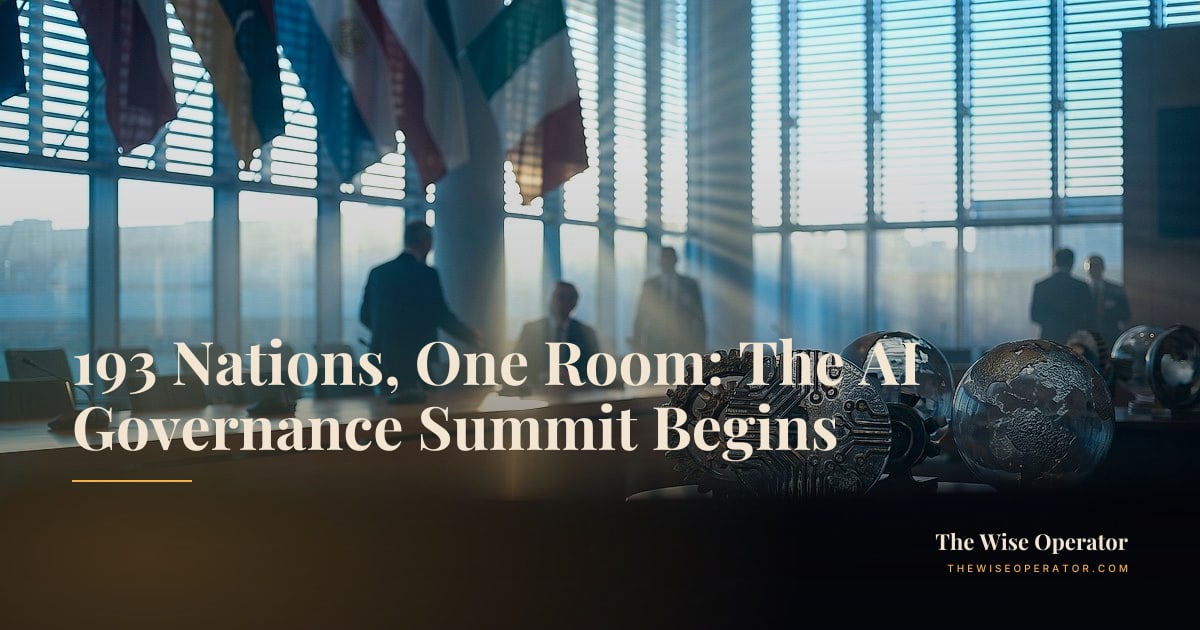
193 Nations, One Room: The AI Governance Summit Begins
The UN Global Dialogue on AI Governance opened in Geneva with all 193 member states. GPT-5.6 launched government-restricted last week. Microsoft embedded 6,000 deployment staff into enterprises. The summit is catching up to decisions already made.
By Scott Krukowski, editor of The Wise Operator
Every UN member state is in Geneva today. The Global Dialogue on AI Governance opened this morning with all 193 nations in the room, the first summit to assemble the full UN membership around a single question: who governs artificial intelligence, and how. The frameworks they are negotiating arrived after the decisions. GPT-5.6 launched last week with access already restricted by government order. Microsoft embedded six thousand deployment staff into enterprise customers the week before. Anthropic updated its regional restrictions to enforce access rules in markets it cannot legally serve. The world is not waiting for Geneva to decide. Geneva is trying to catch up.
The Lead: The UN Global Dialogue on AI Governance Opens in Geneva
All 193 UN member states convened in Geneva today for the Global Dialogue on AI Governance, the first summit to assemble the full United Nations membership around AI policy, with Nvidia’s Jensen Huang, Amazon’s Andy Jassy, and Microsoft’s Brad Smith seated alongside heads of state from Rwanda, Estonia, Saudi Arabia, Singapore, and Nigeria.
The two-day summit, organized by the UN and the ITU, is the formal follow-on to the AI for Good Global Commission announced last week. The agenda is contested: delegates are debating whether AI governance should produce binding treaty obligations, voluntary soft-law frameworks, or a hybrid model where national jurisdictions retain primary authority while international bodies coordinate on safety standards (UN News).
The ai-governance-framework debate is not theoretical. Three developments from the past ten days show why. The US Department of Commerce imposed and then lifted export controls on Claude Fable 5 within three weeks. An unnamed US partner government asked OpenAI to restrict the GPT-5.6 Luna variant before its public launch. Colorado’s AI liability law took effect June 30, creating state-level compliance obligations that federal standards have not yet resolved. Each of these was a unilateral decision by a single jurisdiction. Geneva is the attempt at coordination. The patchwork already exists.
“The question is not whether AI will be governed. It already is, jurisdiction by jurisdiction. The question is whether those jurisdictions will speak to each other before they contradict each other.”
What Reaches Your Screen
Three consumer-facing developments this week lower the cost and expand the reach of AI tools available to anyone with a phone: Tesla’s robotaxi reached Miami, ChatGPT’s memory got meaningfully better for free users, and Google’s personalized image generation opened to everyone in the US.
Tesla launched driverless robotaxi service in Miami on July 3, the first expansion of its autonomous vehicle program outside California and Texas (Electrek). The Miami service covers roughly forty square miles, runs without a safety driver, and prices like standard rideshare. For users in the coverage zone, this is the first time autonomous vehicle service is available at commodity pricing. This is not a pilot.
OpenAI rolled out Dreaming V3 to free ChatGPT users over the weekend, a memory upgrade that raises accuracy on cross-session recall from 9.4% to 75.1% in internal testing (BleepingComputer). That gap is large enough to change what free users can actually do with the product. Persistent memory is the difference between a chatbot and an assistant.
Google made personalized image generation available at no cost to US users in the Gemini app and web interface (TechCrunch). The feature uses uploaded reference images to generate new images consistent with a specific person’s appearance. It was a paid-tier exclusive six weeks ago.
“Each of these was a premium feature six weeks ago. Each is free or near-free today. The consumer AI floor is still moving.”
What’s Moving Underneath
The week’s macro story is a set of structural moves by the labs that make the governance summit in Geneva both more urgent and harder to execute.
OpenAI launched GPT-5.6 in three variants: Sol, Terra, and Luna. The Luna variant was restricted by request from an unnamed government partner before the public launch, the first time a government has asked a US lab to restrict a specific model’s rollout before it went live. OpenAI complied and stated publicly that such restrictions “shouldn’t be the norm” (TechCrunch). The statement is notable precisely because the company that made it had already complied. The frontier is already being governed. The question is whether any of that governance is coordinated.
Microsoft launched Frontier Co., a standalone AI deployment company capitalized at $2.5 billion with six thousand embedded staff (TechCrunch). These are not consultants placed temporarily. They are employees placed inside customer organizations on multi-year arrangements to drive AI adoption from within. The structure makes AI adoption operationally difficult to reverse: the staff, the workflows, the systems, and the institutional knowledge become part of the customer’s organization. Whatever governance frameworks Geneva produces, they will apply to organizations where Microsoft staff are already embedded.
Anthropic updated its regional access policies to explicitly prohibit resale and access in markets it cannot legally serve under current export control rules, including mainland China (Anthropic). The move is compliance-driven. It reflects the same patchwork reality GPT-5.6’s restriction reflects: labs navigating national rules in real time, without a coordinating framework. Geneva is the attempt at that framework. It opened this morning after the decisions were already made.
One Tool Worth Knowing
Anthropic released Claude Science as a dedicated AI workbench for scientific research, available inside Claude.ai. It connects to literature databases, runs Python for data analysis, generates structured research summaries, and assists with experiment design at a depth the standard Claude interface does not support. The tool is not for general productivity. It is for operators and teams doing actual research work: reading papers, synthesizing findings, running quantitative analysis, or building the knowledge base for a grant application or policy brief.
The meaningful test is whether it changes the time cost of literature synthesis. Give it a research question with a narrow scope, point it at a topic where you already know the major papers, and ask it to identify what the field has not yet resolved. That is a task that takes a researcher several hours. Run the test with a question you already know the answer to first, so you can calibrate how much to trust the output you cannot independently verify. For operators doing policy or regulatory work, it is worth testing specifically on questions where you need to map what has been published before you can say anything original.
Wisdom Speaks
“Come, let us build ourselves a city and a tower with its top in the heavens, and let us make a name for ourselves.” Genesis 11:4, ESV
The tower at babel did not fail because the builders were evil. They were unified, efficient, and building fast. God’s observation in verse 6 is the part worth sitting with: “nothing that they propose to do will now be impossible for them.” The capacity arrived before the question of whether it should. One hundred and ninety-three nations in the same room is not automatically wisdom. It is the precondition for either genuine coordination or a very organized form of what Babel was.
“Distrust everything which rejoices in the crowd, everything which the crowd applauds and to which it runs.” Seneca, Letters to Lucilius, Letter 2, ca. 65 AD
Seneca wrote this as a warning about philosophy. The operator reads it today as a warning about consensus. When the entire world agrees that something must be governed, the danger is not that nothing gets done. The danger is that governance becomes the goal and the foundational question, what is all of this for, never gets forced. The babel check is not pessimism. It is the specific kind of discernment that asks whether what we are building matches what we are meant to do. That question is not answered in Geneva. It is answered, if it is answered at all, in the quieter place where ambition is not in the room.
Thursday’s digest: 57,000 Jobs in June, $49 Billion for AI, on the labor market split and the sovereign capital flowing into AI infrastructure. Sunday’s reflection: The Easy Yoke, on partnership and burden in a season of relentless updates. Today’s governance summit arrives downstream of both: the capital described in Thursday’s numbers is building what Geneva is now trying to govern.
From the Editor
Got a half-formed idea you want to put to work? Let's sharpen it into a build plan.
Prototype Your IdeaA short interview that turns your idea into a structured build plan. Takes about five minutes.