Sunday Reflection
Sunday Reflection: The Easy Yoke
Jesus said his yoke is easy and his burden light, in a season when the operators who build with AI have never felt more burdened. Here is what he actually meant.
By Scott Krukowski, editor of The Wise Operator
Each Sunday, The Wise Operator steps away from the news to sit with Scripture and ask what ancient wisdom means in the age of AI.
It is Sunday. The inbox has not stopped. The models have not stopped updating. This morning is not for catching up.
This Week’s Reading: Matthew 11:25-30
From Matthew 11:25-30:
“At that time Jesus said in reply, ’I give praise to you, Father, Lord of heaven and earth, for although you have hidden these things from the wise and the learned you have revealed them to the childlike. Yes, Father, such has been your gracious will. All things have been handed over to me by my Father. No one knows the Son except the Father, and no one knows the Father except the Son and anyone to whom the Son wishes to reveal him.
Come to me, all you who labor and are burdened, and I will give you rest. Take my yoke upon you and learn from me, for I am meek and humble of heart; and you will find rest for yourselves. For my yoke is easy, and my burden light.’“
What This Means in the Age of AI
The passage opens mid-chapter, in a stretch of Matthew textured by labor not yet producing fruit. Towns have seen the miracles and not changed. John’s disciples have come asking whether Jesus is truly the one. Into that, Jesus stops and gives thanks, not for a success but for a paradox: the Father has hidden these things from the wise and revealed them to the childlike.
The Greek word is nēpiois, infants. Those who have not yet accumulated enough sophistication to argue themselves past the obvious. The scholar who can rehearse every nuance of the tradition has sometimes, by sheer weight of knowledge, managed to miss what a beginner sees on the first morning.
This lands with force right now. The world has never produced more analysis of what AI is going to do. The frameworks multiply faster than anyone can hold them. And below all that analysis, most people actually building with these tools are asking something simpler: am I getting less burdened, or just more?
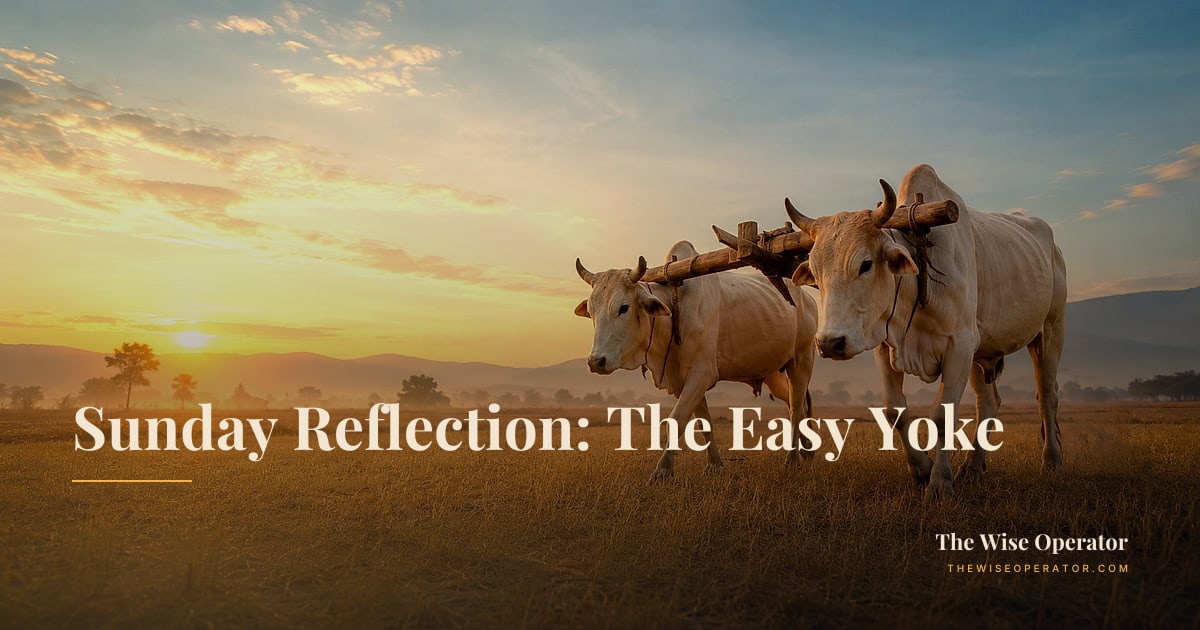
Jesus answers directly. Come to me, all who labor and are burdened. Then he offers a zugos, a yoke. Not release from work. A farming implement designed to bind two draft animals together so the stronger one carries the heavier share. He is not offering to take the work away. He is offering to be alongside in it.
The Zechariah reading that opens this Sunday’s liturgy sets the picture. A king who arrives not on a warhorse but on a colt, who bans the chariot and the warrior’s bow and proclaims peace. This is not a weak king. It is a king whose power needs no performance.
Jesus names this same quality in Matthew 11:29. “I am meek and humble of heart,” claiming prautes as the virtue that makes his yoke easy. The English word meek has not survived well. In Greek, prautes described a war horse fully trained: enormous force under complete discipline. The strength that does not scatter because it has nowhere to prove itself.
The burden most operators carry now is not purely volume. It is the relentless logic of a field that announces, every quarter, that last quarter’s knowledge is no longer enough. Every tool that promised to make the stack lighter has added its own weight to the stack.
The offer in Matthew 11 is not a productivity promise. It is a different kind of partnership. The yoke is easy, Jesus says, not because the work disappears but because the one carrying it with you is not exhausted, not performing, and does not announce new capabilities every Tuesday. The menuchah this passage promises, rest that is its own gift rather than the mere absence of effort, comes in the yoke. Not after it.
Carry into the week the question the childlike ask and the sophisticated often skip: is the partner I am building alongside actually helping carry the weight, or am I carrying both of us? The offer is still open.
The Other Readings
The First Reading, Zechariah 9:9-10, announces a just and meek king who bans the chariot and proclaims peace: power that does not need to perform itself. The Responsorial Psalm 145:1-2, 8-9, 10-11, 13-14 sings of a God who lifts all who are falling and raises all who are bowed down. The Second Reading, Romans 8:9, 11-13, completes the arch: life in the Spirit is not a lighter schedule but a different source of movement, the same Spirit that raised Christ from the dead now the operative energy in the body.
A Closing Prayer
Lord, you promised rest not after the work but in the yoke. Teach us to stop building systems of self-sufficiency and come to where you already are. Give us the meekness that is not weakness but the strength that has nothing to prove. Let us carry this week’s work alongside you, lighter than we could make it alone, in the name of the one who said his burden is light. Amen.
From the Editor
Got a half-formed idea you want to put to work? Let's sharpen it into a build plan.
Prototype Your IdeaA short interview that turns your idea into a structured build plan. Takes about five minutes.