
The Wire
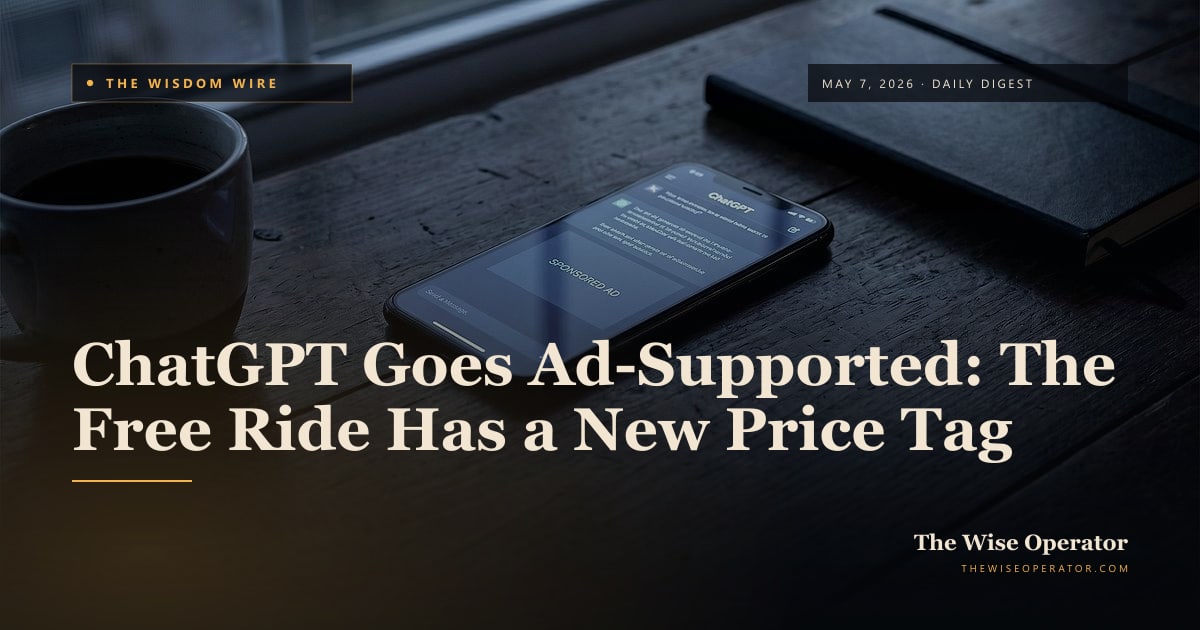
ChatGPT Goes Ad-Supported: The Free Ride Has a New Price Tag
OpenAI took ChatGPT ads to five new countries and opened a self-serve manager with CPC bidding. The free AI tool is now an ad-supported consumer product.
By Scott Krukowski, editor of The Wise Operator
Something quietly changed this week in how the AI industry intends to make money from you. Not from enterprises paying six-figure API contracts. From you, reading answers on your phone in the morning. The infrastructure layer has been crystallizing all week: compute deals, funding rounds, regulation timelines. Today the consumer business model crystallized on top of it. ChatGPT is now, officially, an ad-supported product. And that single fact changes the relationship between the tool and the person using it in ways that most operators have not yet accounted for.
This is the week to start accounting for it. Today’s digest covers conversational advertising as a product category, what the consumer AI apps you already use are doing to earn your continued attention, and the macro scaffolding being built underneath all of it.
The Lead: ChatGPT Pivots to Ad-Supported Consumer Product
OpenAI expanded its ChatGPT advertising pilot to the UK, Mexico, Brazil, Japan, and South Korea on May 7, simultaneously opening a self-serve Ads Manager to U.S. advertisers of all sizes, completing ChatGPT’s pivot from research tool to ad-supported consumer platform.
The mechanics are more mature than most observers expected. The new Ads Manager includes cost-per-click bidding, pixel-based conversion tracking, and a Conversions API: the same infrastructure architecture that made Google Ads and Meta Ads scalable self-serve ecosystems. What OpenAI has built is not a banner ad layer on top of a chatbot. It is a structured advertising platform inside a conversational interface, where the ad surface is the answer itself.
The targeting question is not yet fully public. What is public: ads are limited to Free and Go tier users. Plus and above see no ads. That bifurcation is deliberate and worth noting. OpenAI is not asking its paying subscribers to subsidize the advertising experience. It is telling free users that the price of free is now their attention to sponsored content inside the answer flow. The company is also telling advertisers something: these are users who chose not to pay, which is a different audience profile than a paid subscriber who has already expressed high intent and willingness to spend.
For operators who have built workflows that depend on ChatGPT’s free tier for internal tooling or client-facing demos, today’s announcement matters. The tool your team has been using as a neutral research surface is now a platform that surfaces sponsored responses alongside organic answers, without structural separation the way a search results page might draw a line between ads and results. The question is not whether the ads are ethical. The question is whether you have a process for knowing when you are reading an answer and when you are reading an advertisement (Digiday).
What It Means for You
The consumer AI apps you use daily are all moving in the same direction this week: more polished, more personalized, more embedded in your decisions, and more clearly defined as products with business models behind them.
OpenAI added a feature to ChatGPT that sits on the opposite end of the commercial spectrum from the ads expansion. The new Trusted Contact safety feature is opt-in and available to adult users globally across all tiers. Users designate a person who can be notified if OpenAI’s systems and trained reviewers determine the user may be in a self-harm crisis. The notification is deliberately limited: no transcripts, no conversation details, just a flag. This is the parental-controls logic that has existed for teen accounts extended to adults who want a safety net. Two announcements in one day, one expanding commercial reach and one expanding human safety, both reflecting the same underlying truth: OpenAI now operates a consumer product at scale, with all the obligations and opportunities that entails.
The same consumer quality push is visible at Anthropic. Mike Krieger, the Labs co-lead and Instagram co-founder, said at this week’s Code with Claude conference that consumer “quality, polish, and performance” is now an explicit focus. Anthropic’s Claude app cold-start time dropped from five to six seconds down to roughly one second. The app currently sits at number two in the U.S. Apple App Store free charts, between ChatGPT and Gemini. One second versus six is not a technical footnote. It is the difference between a tool you reach for and a tool you tolerate.
“One second versus six is the difference between a tool you reach for and a tool you tolerate.”
The same urgency around consumer quality has arrived in the productivity tools you already pay for. Notion’s Custom Agents exited beta on May 4 and 5 with usage-based credit pricing on Business and Enterprise plans, per-agent credit limits, workspace spending caps, alerts, automatic pause on credit exhaustion, and a central usage dashboard. Over one million agents were created during the two-month beta. The new Custom Agent Directory launched May 6. What this tells you is that agentic AI has crossed from developer playground into enterprise product management: someone at Notion had to build a credit and cap system before they could ship this to business users, because real products have real cost controls.
What’s Moving Underneath
The week’s macro story is infrastructure crystallizing into durable commercial assets at every layer of the stack, from chips to regulation to capital.
The most concentrated announcement package of the week came from Anthropic’s Code with Claude conference. Claude Managed Agents received three new capabilities: “dreaming” (a research preview that lets agents review past sessions to surface patterns and self-improve memory), “outcomes” (define a success rubric, get a webhook when it is met), and multiagent orchestration at general availability, where a lead agent delegates to specialist sub-agents each with its own model, prompt, and toolset. Netflix is cited as an early adopter of the multiagent architecture. Claude Code’s five-hour usage window doubled immediately for Pro and Max subscribers. Opus API rate limits were raised. Anthropic’s 9to5Mac coverage of the conference package came alongside separate CNBC reporting that Dario Amodei disclosed 80x annualized revenue growth from Q1 against a planned 10x, with run rate reportedly crossing $30 billion. Amodei called the pace “too hard to handle” and named it as the root of the company’s compute shortages, which in part explains the new SpaceX Colossus 1 data center deal adding 220,000-plus NVIDIA GPUs to Anthropic’s available capacity.
The regulatory frame in Europe shifted this week in a direction that will matter to every enterprise AI buyer. The European Parliament and Council reached a provisional agreement on the AI Omnibus package, delaying high-risk AI Act obligations from August 2026 to December 2027 for standalone systems, and to August 2028 for AI embedded in regulated products. The European Parliament announcement also added an outright ban on AI-generated non-consensual intimate imagery and extended SME compliance simplifications to small mid-cap companies. For operators building for European markets: the original August 2026 deadline was creating procurement hesitation. That hesitation now has more runway.
At the funding layer, Moonshot AI closed a $2B round at a $20B valuation, led by Meituan’s Long-Z Investment with China Mobile and CITIC PE participating. The valuation is up from approximately $4.3B in November 2025, a five-times jump in six months. April ARR crossed $200M, and total fundraising over the past six months exceeds $3.9B, making Moonshot the most heavily funded Chinese LLM startup of this cycle. None of these three macro stories reach your workflow this week. All of them are the scaffolding that determines which platforms, which compliance regimes, and which competitors are still standing when you go to build next year.
One Tool Worth Knowing
ChatGPT Ads Manager (digiday.com)
If you are a marketer or a business owner who has been running Google or Meta ads, the ChatGPT Ads Manager is worth evaluating now, before the platform matures and CPCs rise. Early entry into a new ad platform consistently produces better returns than waiting for the market to set the price. The self-serve manager is U.S.-only for now, but the targeting and conversion infrastructure is already production-grade: CPC bidding, pixel tracking, and a Conversions API give you the measurement surface you need to actually evaluate performance.
The more important evaluation is not whether to advertise. It is whether the audience is right for your product. ChatGPT Free and Go tier users are a specific cohort: people who tried the product, found it useful, and chose not to pay for it. That is a meaningful signal. If your product serves someone who is aware of AI tools but has not committed to a paid productivity stack, this audience is genuinely worth testing. If your product requires a buyer who has already demonstrated willingness to spend on software subscriptions, the ChatGPT free tier may underperform against a more targeted channel.
For a code-touching next step: connect the Conversions API to your existing conversion tracking infrastructure so you can measure cost-per-acquisition against your other channels before you scale spend. For a non-code-touching next step: before running any ads, use ChatGPT itself to ask about your product category and note what kinds of responses it generates organically. If the model already gives solid unpaid answers in your category, ads in that conversation thread face a high bar. If the model gives thin or generic answers, there is a real opportunity to be the sponsored answer in a space where organic content is weak.
Wisdom Speaks
“Buy the truth, and sell it not; also wisdom, and instruction, and understanding.” Proverbs 23:23, KJV
The verse is a purchasing instruction. Buy truth. Do not sell it. The implication is that truth has a market price, and that the temptation to monetize it is real enough to warrant a direct command against it. What OpenAI has built this week is a platform where the answer surface, which millions of users have treated as a research tool, is now available for purchase by advertisers. The user asks a question. The answer arrives. Inside that answer, sponsored content sits. This is not corruption by dramatic intention. It is the ordinary logic of ad-supported media applied to a new surface. But nepsis, the watchfulness that notices when the heart is being pulled, is exactly what Proverbs is asking of the operator reading this. The medium that delivers the answer is now paid by someone other than the asker. That changes what the answer is. You do not have to refuse to use the tool. You do have to notice the change.
“The cost of a thing is the amount of what I will call life which is required to be exchanged for it, immediately or in the long run.” Henry David Thoreau, Walden, 1854
Thoreau’s accounting is useful here because it is unsentimental. The free tier of ChatGPT has always had a cost. Before today, that cost was primarily your data and your implicit role as a training subject. From today, the cost also includes the attention you surrender to advertisers inside your answers. Thoreau would not moralize at you about that exchange. He would simply ask you to name it honestly, because unnamed costs are the ones that accumulate without your noticing. The proverbs tradition and the Walden tradition agree on one thing: the ledger is always open. The question is whether you are reading it.
The operator’s discipline here is not abstinence. It is accounting. Know which tier of which tool you are using, know who paid for that tier, and know what that payment relationship asks of the answer you are receiving. That is not paranoia. That is discernment.
If today’s ChatGPT ads story makes you want to build a content and outreach pipeline that you control entirely, the Outbound Pipeline workflow at thewiseoperator.com/workflows/outbound-pipeline/ walks through a five-stage AI workflow for turning an ICP definition into auditable, personalized outreach drafts in Gmail. The whole point of building your own pipeline is that it does not depend on someone else’s ad-supported defaults to deliver your message.
Yesterday’s digest: OpenAI Makes GPT-5.5 Instant the Default, on the model rotation that quietly changed what your free-tier queries are running on. Earlier this week: Anthropic and OpenAI Wall Street JVs, on the mimetic rivalry driving both labs toward institutional capital. Monday: Cerebras IPO at $26B, on the chip-layer commerce that makes all of this week’s consumer product announcements possible. Today’s ads expansion is what happens when the infrastructure and capital layers mature enough that the consumer business model can finally be built on top of them.
From the Editor
Got a half-formed idea you want to put to work? Let's sharpen it into a build plan.
Prototype Your IdeaA short interview that turns your idea into a structured build plan. Takes about five minutes.