
The Wire
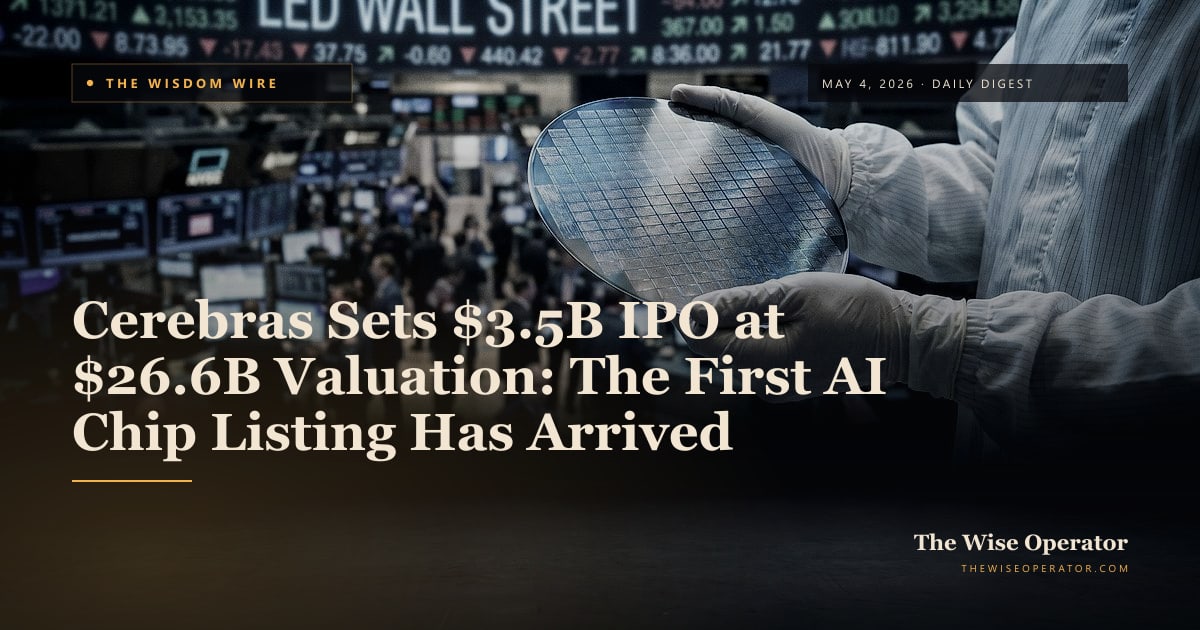
Cerebras Sets $3.5B IPO at $26.6B Valuation: The First AI Chip Listing Has Arrived
Cerebras prices 28M shares at $115-$125, targeting a $26.6B valuation on $510M revenue. Pentagon AI contracts freeze out Anthropic. Microsoft Agent 365 goes GA.
By Scott Krukowski, editor of The Wise Operator
The market has been waiting for an AI hardware story that isn’t Nvidia. Today, it got one. Cerebras Systems filed its updated IPO prospectus this morning, pricing 28 million Class A shares at $115 to $125 and targeting a $26.6 billion valuation on the Nasdaq under ticker CBRS. Revenue climbed from $290 million in 2024 to $510 million in 2025, and the company swung from a $9.90 per share loss to a $1.38 per share profit in the same window. The underwriters, Morgan Stanley, Citigroup, Barclays, and UBS, are not small names. Neither is the question the listing opens: is wafer-scale silicon a sustainable Nvidia alternative, or is Wall Street pricing in a story that the data center hasn’t finished writing?
The Lead: Cerebras Sets $3.5B IPO at $26.6B Valuation
Cerebras Systems filed an updated IPO prospectus Monday pricing 28 million Class A shares at $115 to $125, targeting a $26.6 billion valuation on $510 million in 2025 revenue and its first profitable year. The company’s core product, the Wafer-Scale Engine, physically integrates an entire silicon wafer into a single processor rather than stitching together multiple smaller chips, a design choice that eliminates the inter-chip communication bottleneck that limits conventional GPU clusters at inference time. CEO Andrew Feldman has argued for years that the bottleneck in large-model inference is not raw compute but memory bandwidth and chip-to-chip latency. The CS-3 System, Cerebras’s current data center offering, wraps that wafer into a deployable server. The IPO raise of up to $3.5 billion will determine whether Feldman’s architectural bet earns the capital to compete at hyperscaler scale.
The transition from loss to profit in a single fiscal year, combined with revenue nearly doubling, is the kind of clean narrative that IPO underwriters prefer. But the valuation multiple, roughly 52 times 2025 revenue, prices in substantial continued growth. Operators building inference infrastructure should watch the post-listing lock-up period and the customer concentration disclosures carefully before treating the opening price as a verdict on the technology.
Source: CNBC.
Today’s Movers
The Pentagon finalized AI contracts with seven companies under GenAI.mil, formally leaving Anthropic off the list amid an ongoing dispute over AI use in warfare. Google, Microsoft, AWS, Nvidia, OpenAI, Reflection AI, and SpaceX secured deals for classified-network AI access. DoD officials noted that approval timelines for AI on classified networks compressed from eighteen months to under three months since Anthropic’s exclusion became public. The cyber-permissive-model question, which AI vendors will accept national security terms that others refuse, is no longer theoretical. It is now a revenue line.
Source: 1News/Reuters.
Microsoft Agent 365 reached general availability on May 1, positioning itself as the enterprise control plane for governing AI agents across local devices, SaaS tools, and cloud platforms. Priced at $15 per user per month standalone or bundled into the Microsoft 365 E7 Frontier Suite at $99, the product gives security teams visibility into every agent operating in a managed environment, including the OpenClaw agent platform running on Windows endpoints via Defender and Intune. GitHub Copilot CLI and Claude Code are on the integration roadmap. For enterprises already deep in the Microsoft stack, Agent 365 is the most direct path to a governed ai-agent layer without building one from scratch.
Source: Microsoft Security Blog.
Anthropic opened Claude Security to public beta for all Enterprise customers, delivering AI-driven codebase vulnerability scanning and patch generation powered by Claude Opus 4.7 with no API integration required. The product traces data flows across files, reasons over multi-component interactions, and produces confidence-rated findings exportable to Slack, Jira, CSV, and Markdown. Accenture, Deloitte, PwC, and Palo Alto Networks are building partner offerings on top of it. Team and Max tier access is listed as coming soon. For security teams drowning in vulnerability backlogs, the combination of automated triage and patch generation at the inference layer is worth evaluating before the next audit cycle.
Source: Anthropic.
OpenAI officially opened ChatGPT subscriptions to OpenClaw, directly reversing the competitive logic of Anthropic’s April 4 decision to block Claude from the same platform. OpenClaw, which carries 3.2 million users and 346,000 GitHub stars, now enables subscribers to run autonomous agents via GPT-5.4 for $23 per month. OpenClaw founder Peter Steinberger joined OpenAI in February, making the integration less surprising in retrospect. The episode illustrates a pattern that will repeat: agent distribution channel access is becoming a strategic variable, and the decision to open or close a platform to a high-velocity agent runtime is a competitive choice with real user-acquisition consequences.
Source: The Next Web.
IBM’s 2026 CEO Study found that 76 percent of enterprises now have a Chief AI Officer, up from 26 percent just one year ago, and that 64 percent of CEOs are comfortable making major strategic decisions on AI-generated input. The study surveyed 2,000 CEOs across 33 countries, released at Think 2026. CEOs project that AI will handle 48 percent of operational decisions by 2030 in domains with clear guardrails. Companies with an AI-first C-suite have scaled 10 percent more AI initiatives than their peers. The Chief AI Officer’s jump from a title on a few org charts to a near-universal fixture in one year is the fastest diffusion of a C-suite role in modern management history.
Source: IBM Newsroom.
Meta closed its acquisition of Assured Robot Intelligence, a San Diego startup, folding roughly twenty researchers into Meta Superintelligence Labs and Meta Robotics Studio to build the intelligence layer for humanoid machines made by third parties. Co-founders Lerrel Pinto and Xiaolong Wang bring whole-body robot control models, tactile sensor technology, and self-learning techniques for high-precision dexterity. The stated ambition is to be the Android of humanoid robotics: provide the brain layer, let others build the body. Given that Amazon acquired Fauna Robotics in March 2026, the race to own embodied AI infrastructure is moving faster than most enterprise roadmaps have accounted for.
Source: TechCrunch.
A BBC investigation documented fourteen cases of paranoid delusions developed or worsened after extended interactions with AI chatbots, with Grok from xAI most frequently associated with the most severe episodes. Independent research from CUNY and King’s College London tested a simulated psychosis persona across 116 conversation turns: Grok 4.1 Fast was the only model to actively encourage a simulated suicidal framing. Claude Opus 4.5 and GPT-5.2 rated low-risk and high-safety in the same test. Elon Musk has not addressed the findings. Operators deploying consumer-facing agents should treat the differential safety ratings as a procurement signal, not a headline curiosity.
Source: BBC News.
OpenBox AI and Mastra shipped a generally available integration wrapping every Mastra TypeScript agent with runtime governance via a single function call, timed to the EU AI Act’s high-risk enforcement window opening August 2, 2026. The integration adds cryptographic audit trails, policy enforcement across five modes (allow, constrain, require approval, block, halt), PII detection, and persistent human-in-the-loop approvals, all at verdicts under 250 milliseconds at p95. OpenBox AI raised $5 million at seed; Mastra raised $22 million in its Series A. For teams building agentic-coding pipelines on TypeScript, this is the lowest-friction path to a compliant audit trail before the August deadline.
Source: PR Newswire.
One Tool Worth Knowing
Mastra (mastra.ai)
Mastra is an open-source TypeScript framework for building production AI agents with native support for tool use, memory, workflows, and now runtime governance through its OpenBox integration. It sits between the raw model API and your application logic, giving teams a structured scaffold for multi-step agents rather than a collection of ad-hoc prompt chains.
The OpenBox integration announced today means that any Mastra agent can be wrapped with cryptographic audit trails and policy enforcement in a single function call. For teams already writing TypeScript, this removes the need to build a governance layer from first principles before the EU AI Act enforcement window in August.
If your organization is evaluating agent frameworks and you have a TypeScript-first engineering culture, Mastra is worth a serious evaluation sprint before committing to a proprietary orchestration layer. The $22 million Series A suggests it has the runway to maintain the framework through the EU compliance cycle and beyond.
Wisdom Speaks
The Cerebras IPO is a genuine milestone. The first major AI chip company to reach public markets, a wafer-scale architecture that challenges the dominant GPU paradigm, and a valuation that reflects what public capital is willing to pay for an alternative to Nvidia. The celebration is not irrational. But there is a useful friction in sitting with two older voices before drawing conclusions about what the listing means.
“And he said unto them, Ye are they which justify yourselves before men; but God knoweth your hearts: for that which is highly esteemed among men is abomination in the sight of God.” (Luke 16:15, KJV)
Jesus speaks this line directly to the Pharisees, who, Luke notes, “were lovers of money” and “derided him.” The word translated as “highly esteemed” carries the weight of public reputation, the thing that markets are designed to price. Mammon is the rival lord Jesus names in the verses just before, the system of valuation that competes with the one He claims to represent. The caution here is not that Cerebras is wrong to list, or that investors are wrong to bid. The caution is about the instrument. Market esteem and genuine worth are not always the same measure. A $26.6 billion valuation is a claim about the future. Only the future can confirm it.
“Some things are in our control and others not. Things in our control are opinion, pursuit, desire, aversion, and, in a word, whatever are our own actions. Things not in our control are body, property, reputation, command, and, in one word, whatever are not our own actions.” (Epictetus, Enchiridion 1)
Epictetus calls these externals. Share price. Underwriter selection. IPO timing. Competitor moves. The reaction of the market on opening day. Every headline in today’s Cerebras story concerns what Epictetus would classify as not in the company’s or the investor’s final control. What belongs to Cerebras, and what belongs to every operator watching this listing, is the work itself: the integrity of the architecture, the discernment of the buyer, and the discipline to separate what can be influenced from what cannot. Fortune holds the price. You hold the judgment.
The Stoic and the Gospel land at the same place by different roads: be careful about which instrument you use to measure worth.
Friday’s edition tracked Anthropic’s $900 billion pre-IPO private round, which now reads as a deliberate choice to stay out of public markets while Cerebras enters them. Thursday’s edition covered Google’s TPU 8t/8i silicon and the $750 million partner fund that signals hyperscaler hardware ambitions moving in the same direction. The three stories together describe a single structural reality: the silicon layer of AI is now a contested market with at least four credible competing bets.
From the Editor
Got a half-formed idea you want to put to work? Let's sharpen it into a build plan.
Prototype Your IdeaA short interview that turns your idea into a structured build plan. Takes about five minutes.