
The Cornerstone
Perseverance: The Last Stretch the Tools Won't Finish for You
The pillar of Perseverance for builders in the AI era: staying on the unglamorous last stretch the tools make cheap to start and easy to abandon.
By Scott Krukowski, editor of The Wise Operator
The tools have never been better at starting. A prompt returns a working prototype before your coffee cools: a draft, a schema, a landing page, the whole exciting first version of a thing. What they cannot do is stay. The part that decides whether anything ships, the long unglamorous middle and the harder end, is still yours, and it is exactly the part the fast start tempts you to skip.
Perseverance used to be forced on us. You could not finish quickly, so you had no choice but to endure the slow stretch. The machine removes the friction at the front and leaves it untouched at the back. That is a new kind of test. When beginning is nearly free, the discipline that separates the builder who finishes from the one holding forty half-built things is not talent or speed. It is the willingness to remain under a work past the point where it stops being fun.
Perseverance Is Remaining Under
The Greek the New Testament reaches for is hypomone, and it does not mean gritting your teeth. It is a compound of hypo, under, and meno, to remain: to stay under a weight without being moved out from under it. Not the sprinter’s burst but the load-bearer’s steadiness, the capacity to keep going through a long, costly, or actively resisted stretch until the work is actually finished. Scripture treats it as something suffering produces and endurance perfects, not a mood you summon on the morning you need it.
It is close kin to two words TWO already keeps. Makrothumia is the long temper that waits with difficult people; hypomone is the endurance that waits under difficult circumstances. And emunah, the steady faithfulness that shows up again tomorrow, is what hypomone looks like measured day by day rather than in a single heroic hour. Perseverance in this vocabulary is not intensity. It is refusing to come down off the wall.
The Last Thirty Percent
Name the trap precisely. The engineer Addy Osmani calls it the seventy percent problem: AI tools race you to roughly seventy percent of a working solution, then the last thirty, the edge cases, the security, the integration, the debugging, stays as hard and as slow as it ever was. The tools compressed the fun part and left the finishing untouched. The fast, exciting start is precisely what makes abandoning the final third so tempting, because the next blank prompt is always more thrilling than the tedious close of the last one.
The tools hand you the first draft in an afternoon and none of the discipline the next thousand versions require.
The people who finish have always known this. James Dyson built 5,127 failed prototypes over fifteen years, carrying debt through them, before the bagless vacuum worked. The rust-preventative in nearly every garage is called WD-40 because the chemist got the formula right on the fortieth try, and the lab book never pretended otherwise. Endurance there was not one dramatic push. It was thousands of unglamorous repetitions, failure treated as raw material rather than as a verdict. The tools can now generate a working first prototype in an afternoon, which makes the thousandth iteration feel optional. It is not. It is where the product actually is.
Perseverance Is Built Before It Is Tested
There is a mercy hidden in this, and it is that the slump is predictable. A marathoner hits the wall near mile twenty, when the body burns through its stored glycogen, and a Harvard model can tell you roughly where. The runners who get through it do not out-will the wall in the moment. They prepared for it months earlier: base training, conservative early pacing, steady fueling from the first mile. Perseverance is engineered in advance, not conjured at the point of collapse.
For a builder that means deciding, before the exciting start, what finished actually means, and committing to the boring third before you feel the pull of the next idea. The discipline is not to feel more motivated at mile twenty. It is to have already built the structure that carries you when the motivation is gone.
One Practice Worth Knowing
Pick the one project you are most tempted to abandon at seventy percent, and write its definition of done before you touch it again: the concrete list of what “finished” requires, the edge cases handled, the thing tested, shipped, and closed. Then finish that one to the last ten percent before you are allowed to start anything new.
The rule is simple and it bites: no new blank prompt until the current work crosses its own finish line. AI will always offer you a fresh, thrilling beginning. The practice is to refuse it until the last one is genuinely done, so your attention compounds into finished things instead of scattering across forty exciting starts.
Wisdom Speaks
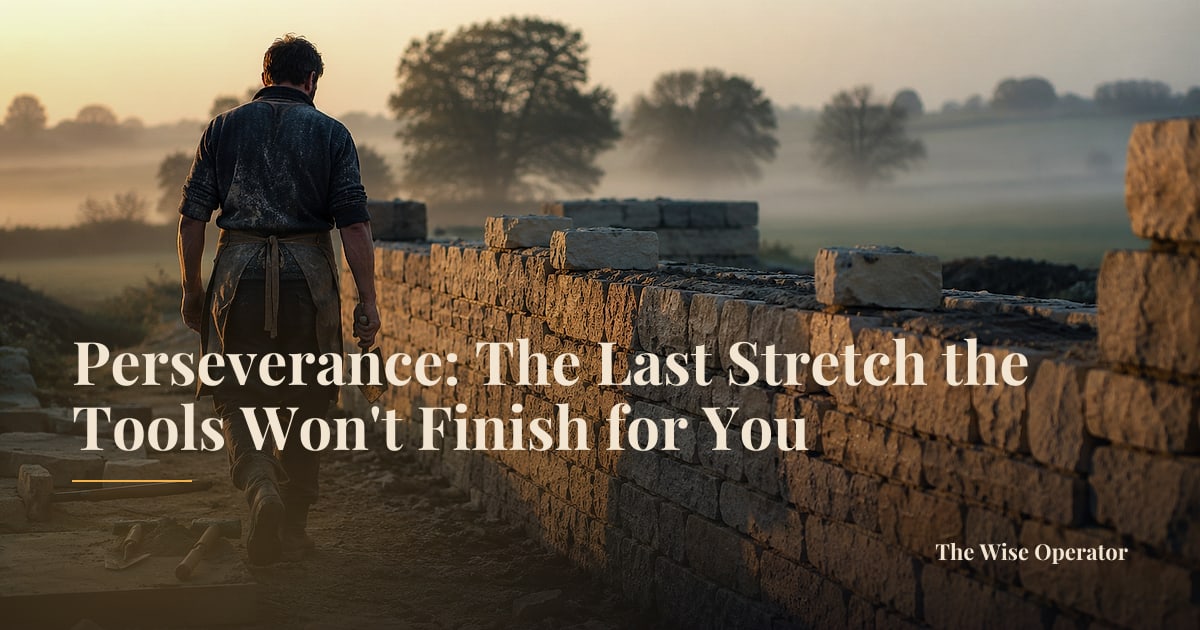
Nehemiah rebuilt Jerusalem’s wall in fifty-two days under a sustained campaign to stop him, his builders working with a tool in one hand and a weapon in the other. When his enemies tried to lure him off the site to “talk,” he sent back one of the great lines of operator endurance:
“I am doing a great work, so that I can’t come down. Why should the work cease, while I leave it, and come down to you?” Nehemiah 6:3, WEB
That is hypomone with a wall in front of it. The threat was not slowness; it was the constant, reasonable-sounding invitation to step away from the unfinished work for something more urgent, more interesting, easier. Every abandoned project dies at exactly that invitation. The perseverance Scripture commends is not the absence of easier options. It is the refusal to come down off the wall while the work is still open.
And it is never mere grit. Nehemiah kept building because the city and its people depended on it, a cause outside himself, the same emunah that returns to the work the next morning because someone is counting on the finished thing. What half-built wall is asking you to come down today, and what would it take to stay on it until the last course is laid?
This is the sixth pillar in the Cornerstone rotation, following Monday’s turn on Diligence: diligence keeps a watchful hand on the work the tools produce, and perseverance keeps that hand there until the work is finished.
From the Editor
Got a half-formed idea you want to put to work? Let's sharpen it into a build plan.
Prototype Your IdeaA short interview that turns your idea into a structured build plan. Takes about five minutes.