Sunday Reflection
Sunday Reflection: Let Both Grow Together
The Parable of the Weeds forbids the very thing our tools now make effortless: the instant, confident sorting of the good from the bad before the harvest.
By Scott Krukowski, editor of The Wise Operator
Each Sunday, The Wise Operator steps away from the news to sit with Scripture and ask what ancient wisdom means in the age of AI.
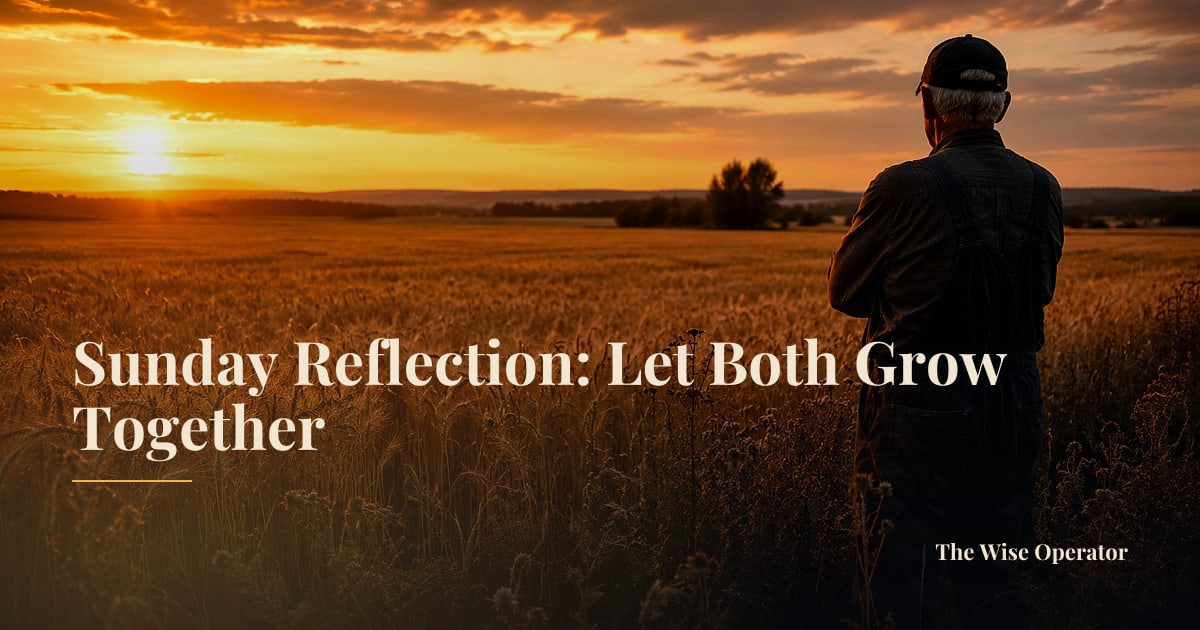
It is Sunday, and the field can wait. Six days a week the work is to tell one thing from another: what matters from what does not, what is true from what is not, what to keep from what to cut. This morning asks for a different posture. Not sharper sorting, but the patience to let some things stand unsorted a little longer.
This Week’s Reading: The Weeds Among the Wheat
From Matthew 13:24-43:
He set another parable before them, saying, “The Kingdom of Heaven is like a man who sowed good seed in his field, but while people slept, his enemy came and sowed darnel weeds also among the wheat, and went away. The servants of the householder came and said to him, ‘Sir, didn’t you sow good seed in your field? Where did this darnel come from?’ He said to them, ‘An enemy has done this.’ The servants asked him, ‘Do you want us to go and gather them up?’ But he said, ‘No, lest perhaps while you gather up the darnel weeds, you root up the wheat with them. Let both grow together until the harvest, and in the harvest time I will tell the reapers, “First, gather up the darnel weeds, and bind them in bundles to burn them; but gather the wheat into my barn.”’“
He answered them, “He who sows the good seed is the Son of Man, the field is the world, and the good seed, these are the children of the Kingdom, and the darnel weeds are the children of the evil one. The enemy who sowed them is the devil. The harvest is the end of the age, and the reapers are angels. As therefore the darnel weeds are gathered up and burned with fire, so will it be at the end of this age. The Son of Man will send out his angels, and they will gather out of his Kingdom all things that cause stumbling, and those who do iniquity, and will cast them into the furnace of fire. There will be the weeping and the gnashing of teeth. Then the righteous will shine forth like the sun in the Kingdom of their Father. He who has ears to hear, let him hear.”
What This Means in the Age of AI
The field here is not the soul, the way the ground was in the parable of the sower earlier in this same chapter. Jesus says plainly that the field is the world. The weeds and the wheat grow in one soil, their roots wound together, and for most of the season they are nearly impossible to tell apart. Darnel is a weed that mimics wheat until the heads form. The servants see the problem and want to do the obvious thing: go through the field and pull the weeds now. The master says no. Not because he is indifferent to the weeds, but because the sorting cannot be done cleanly yet, and pulling too early tears up the wheat.
That restraint has a name in the New Testament. The Greek is makrothumia, usually translated patience or forbearance, literally a long temper. It is the deliberate withholding of a judgment you have the power to make. The First Reading strikes the same note: the Book of Wisdom praises a God whose very mastery is the source of his leniency, who judges with clemency and teaches his people that the one who is just must also be kind. Power that could sort in an instant chooses to wait.
We are the first generation that can sort at scale without waiting. The defining move of the new machines is exactly the one the master forbids: run the whole field through a classifier, flag every questionable head, act on the flag in milliseconds. A safety-classifier does in a second what a farmer could not do in a season. And the temptation that rides in with the capability is the servants’ temptation, now armed. When you can separate, you assume you should.
The parable is not against judgment. It is against premature and self-appointed judgment. The sorting does happen. It happens at the harvest, and it is done by the reapers the master sends, not by the servants who noticed the weeds first. What Jesus takes out of human hands is not discernment but the final verdict. To tell wheat from weed is a daily labor. To declare a person irredeemably weed and act on it is a judgment reserved for the end, and for God.
There is mercy hidden in the delay. Darnel cannot become wheat, but a person counted among the weeds today can still repent tomorrow, and every hour the harvest waits is an hour that door stays open. The patience is not slowness. It is room left for grace. When your tools make instant separation cheap, the discipline is to ask which sortings are yours to make now, and which belong to a harvest you are not the reaper of.
Carry one question into the week. Where have you been handed the power to pull weeds, and where would pulling them now tear up wheat you cannot yet see?
The Other Readings
The First Reading, Wisdom 12:13, 16-19, praises a God whose strength shows itself in restraint: he governs with much lenience and judges with clemency, and by these deeds teaches his people that the just must be kind. The Responsorial Psalm 86:5-16 answers in the same key: “you, Lord, are a merciful and gracious God, slow to anger, and abundant in loving kindness and truth.” The Second Reading, Romans 8:26-27, turns to our own weakness: we do not know how to pray as we ought, but the Spirit himself intercedes for us with groanings that cannot be uttered, and the God who searches hearts knows the mind of the Spirit.
A Closing Prayer
Lord, you who could sort the field in an instant and do not, teach us your patience. Where we have been handed the power to separate and to judge, give us the restraint to leave the harvest in your hands, and the discernment to tell the labor that is ours from the verdict that is yours alone. Keep the door of repentance open in us, and in everyone we were tempted to count as weeds. Let us grow toward the light until the day you send your reapers. Amen.
From the Editor
Got a half-formed idea you want to put to work? Let's sharpen it into a build plan.
Prototype Your IdeaA short interview that turns your idea into a structured build plan. Takes about five minutes.