Sunday Reflection
Sunday Reflection: The Sower and the Ground
The Parable of the Sower names something the age of AI has made urgent: the problem is no longer scarce seed. The question is what kind of ground the word is finding.
By Scott Krukowski, editor of The Wise Operator
Each Sunday, The Wise Operator steps away from the news to sit with Scripture and ask what ancient wisdom means in the age of AI.
Every week now ends with more than it started. This morning does not ask you to add more. It asks you to listen.
This Week’s Reading: Matthew 13:1-23
From Matthew 13:1-23:
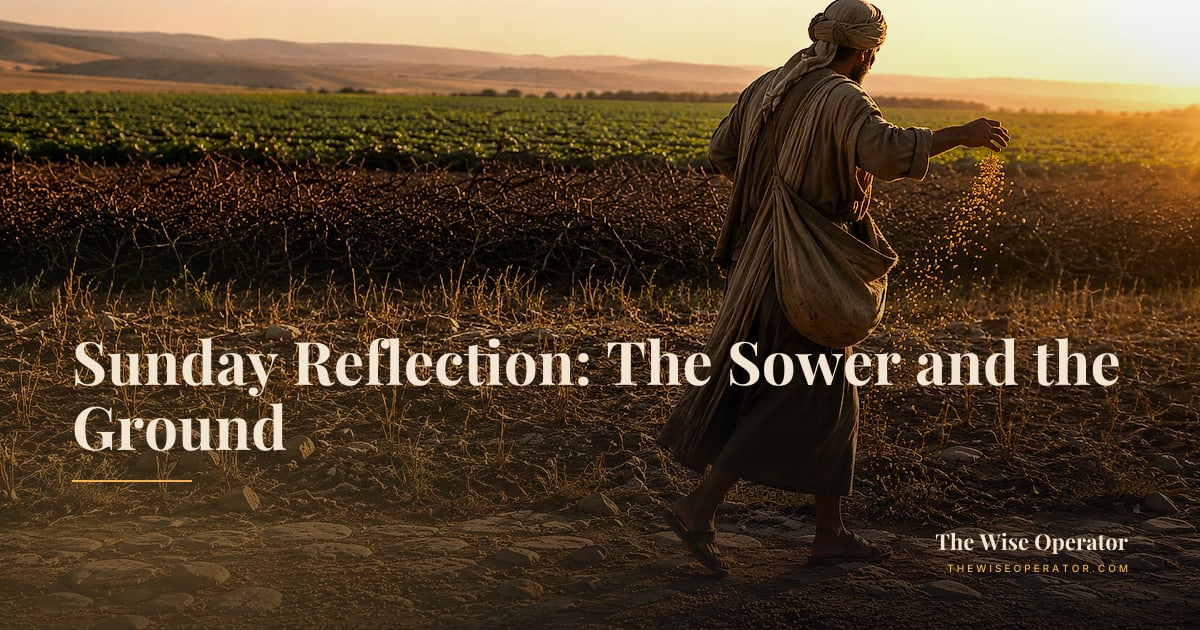
“On that day, Jesus went out of the house and sat down by the sea. Such large crowds gathered around him that he got into a boat and sat down, and the whole crowd stood along the shore. And he spoke to them at length in parables, saying: ‘A sower went out to sow. And as he sowed, some seed fell on the path, and birds came and ate it up. Some fell on rocky ground, where it had little soil. It sprang up at once because the soil was not deep, and when the sun rose it was scorched, and it withered for lack of roots. Some seed fell among thorns, and the thorns grew up and choked it. But some seed fell on rich soil and produced fruit, a hundred or sixty or thirtyfold. Whoever has ears ought to hear.’”
Jesus then explained: “The seed sown on the path is the one who hears the word of the kingdom without understanding it, and the evil one comes and steals away what was sown in his heart. The seed sown on rocky ground is the one who hears the word and receives it at once with joy. But he has no root and lasts only for a time. When some tribulation or persecution comes because of the word, he immediately falls away. The seed sown among thorns is the one who hears the word, but then worldly anxiety and the lure of riches choke the word and it bears no fruit. But the seed sown on rich soil is the one who hears the word and understands it, who indeed bears fruit and yields a hundred or sixty or thirtyfold.”
What This Means in the Age of AI
The sower in first-century Palestine did not plant with precision. He walked the field and threw, accepting waste as the condition of the harvest. The hard path, the thin rocky soil, the thorny ground: these are not failures of the sower. They are the conditions of broadcast sowing. The hundredfold return on good soil was the kind of yield that changed a family’s position precisely because a great deal of seed went nowhere.
What the disciples wanted to know, once the crowd dispersed, is what the parable meant. The answer Jesus gives places the burden on the hearer. Seed and sower are fixed; ground is the variable. And the ground is not terrain that happens to you. It is attention, depth, and freedom from anxiety, each of which the reader can do something about.
The First Reading from Isaiah holds the theological center. God’s word, the Hebrew dabar, does not return empty. A dabar is not merely communication; it is an act that accomplishes what it is sent to accomplish. Isaiah is not claiming that every listener understands. He is claiming that the divine word arrives with a purpose and completes it regardless. The sower’s losses do not touch the dabar. The word reaches the ground that can receive it and does its work there.
The contrast with this moment is direct. AI now produces more text in a day than a professional writer produces in a year. The problem of the age has inverted. Seed is not scarce. Every tool, every automated touchpoint, every newsletter, every agent is throwing. The question the parable presses is not whether you can produce more. It is the question Jesus makes the entire story about: what kind of ground is your output actually reaching?
Romans 8:18-23 runs underneath this. Paul writes that all creation groans in labor pains, waiting for something not yet visible. The groaning is not despair. It is the posture of something that knows what it was made for and has not yet arrived. The operator who builds in a field that changes every quarter may recognize that sound. Not every word will fruit. Some will be eaten immediately; some will wither; some will be choked. The assurance in Isaiah is not that every piece of seed you throw will bear fruit. It is that work sent with a real purpose can accomplish what it is sent to do, in the ground that can receive it.
Carry into this week a question that only comes clear when the throwing stops: of what you are building, how much is landing on ground prepared to receive it? That pause is what discernment has always required. The disciples ask Jesus this question after the crowd leaves. You can only ask it when you step back from the sowing long enough to look at where things have actually landed.
The Other Readings
The First Reading, Isaiah 55:10-11, presses the central image: God’s word goes forth like rain and does not return empty, but accomplishes what it is sent to do. The Responsorial Psalm 65:10, 11, 12-13, 14 is a song of watered earth, furrows drenched, the year crowned with bounty: the good ground having received the rain. The Second Reading, Romans 8:18-23, adds the temporal frame: creation groans in labor pains, awaiting a glory not yet revealed, and we groan with it, holding the firstfruits of the Spirit while the harvest is still coming.
A Closing Prayer
Lord, the field is full of seed. Make us the kind of ground that can receive what you send. Quiet the anxiety that chokes it, break up the hardness that turns it away, root us deep enough that the sun does not scorch what you have planted. Let what you speak accomplish what you send it to do, in us and through us. Amen.
From the Editor
Got a half-formed idea you want to put to work? Let's sharpen it into a build plan.
Prototype Your IdeaA short interview that turns your idea into a structured build plan. Takes about five minutes.