Sunday Reflection
Sunday Reflection: The Room on the Roof
What the Shunammite woman built on her rooftop, and what Jesus said about a cup of cold water, names the smallest, most refusable choice an operator makes this week.
By Scott Krukowski, editor of The Wise Operator
Each Sunday, The Wise Operator steps away from the news to sit with Scripture and ask what ancient wisdom means in the age of AI.
It is Sunday. The week’s news has been loud, and it will be loud again tomorrow. For a few hours the office of the digest is closed. The point of this morning is not to keep up. The point is to sit with something that does not move when the news moves.
This Week’s Reading: Matthew 10:37-42
From Matthew 10:37-42:
“Whoever loves father or mother more than me is not worthy of me, and whoever loves son or daughter more than me is not worthy of me; and whoever does not take up his cross and follow after me is not worthy of me. Whoever finds his life will lose it, and whoever loses his life for my sake will find it. Whoever receives you receives me, and whoever receives me receives the one who sent me. Whoever receives a prophet because he is a prophet will receive a prophet’s reward, and whoever receives a righteous man because he is righteous will receive a righteous man’s reward. And whoever gives only a cup of cold water to one of these little ones to drink because he is a disciple, amen, I say to you, he will surely not lose his reward.”
What This Means in the Age of AI
Jesus is sending out the Twelve when he says this. The verses just before it are about division, about a sword, about a household set against itself. Then, abruptly, the camera turns. He stops telling the disciples what it will cost them and starts telling them what it will cost the people who receive them. A cup of cold water given to one of these little ones, he says, will not lose its reward.
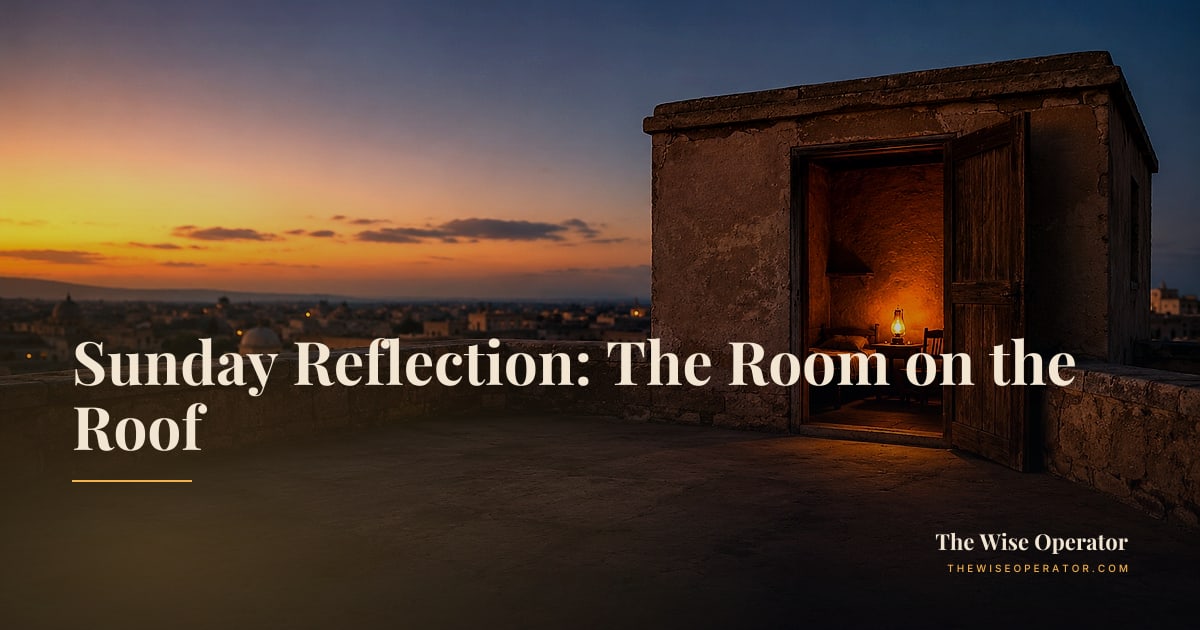
The First Reading sets the picture under it. A woman of means in Shunem notices Elisha passing through, and she does not just feed him once. She tells her husband, “let us build a small room on the roof, with a bed, a table, a chair, and a lamp.” She makes a place for the prophet she does not yet need. The Gospel finishes the arc the Shunammite woman begins: receive the messenger, and you receive the One who sent him.
What this names, in plain Greek, is philoxenia, love of the stranger. It is the New Testament’s word for hospitality, and it is not the dinner-party word we have made it. It is the discipline of receiving a person you did not choose, because the kingdom turns on whether you let them in.
The age of AI is the age of the perfectly filtered inbox. Cold messages get triaged out before a human reads them. Calendars are guarded by assistants that never sleep. Every interruption can be summarized, every stranger can be routed, every cup of cold water can be drafted by a model that learned what your tone usually sounds like. The machine is not the problem. The machine is doing the work we asked it to do. The problem is that the operator who delegates well can quietly stop being a person to whom anyone arrives.
The Shunammite woman did not build the room on the roof because Elisha asked. She built it because she saw him pass by and decided that her house would be the kind of house where a prophet had somewhere to sleep. She made the room before the need. That is the part the Gospel honors. Not the heroic welcome of someone famous after they are already famous. The unspectacular decision to keep a chair empty for a person who has not arrived.
This is the question the day’s silence puts to us. Not what would you do for a prophet. What does your week look like to a stranger. Whose message do you let through. Whose name do you remember at the door of your attention. When a model can answer for you, what answer are you sending in your own voice, and to whom. The cup of cold water is small. That is the point. The reward is attached to the smallness, because the smallness proves it was given on purpose.
This is also where Sunday’s philoxenia meets the older word for Christian work, diakonia. Diakonia asks which service is rightly entrusted to you. Philoxenia asks who is rightly received by you. The two questions stand at different doors of the same house, and the operator who keeps both doors open does not have to ask which is more important. One feeds the other.
Carry into the week the one welcome you would let a model write for you, and write it yourself instead. Not because the model is wrong. Because the welcome is yours to give.
The Other Readings
The First Reading, 2 Kings 4:8-11, 14-16a, is the Shunammite woman who builds the upper room for Elisha and is promised a son. The Responsorial Psalm 89 sings of God’s enduring kindness across generations, the same fidelity the woman pours into a stranger. The Second Reading, Romans 6:3-4, 8-11, reminds the baptized that they have already died with Christ and now live a life that belongs to him, which is the life out of which any real welcome comes.
A Closing Prayer
Lord, you said that the smallest welcome would not lose its reward. Give us the eyes to see whom you are sending this week, and the slowness to read the message before our tools answer it for us. Build in our house the small room on the roof, ready before the prophet arrives. And when the cup of cold water is ours to give, let it come from our own hand, in your name. Amen.
From the Editor
Got a half-formed idea you want to put to work? Let's sharpen it into a build plan.
Prototype Your IdeaA short interview that turns your idea into a structured build plan. Takes about five minutes.