Sunday Reflection
Sunday Reflection: A Bread You Cannot Eat Alone
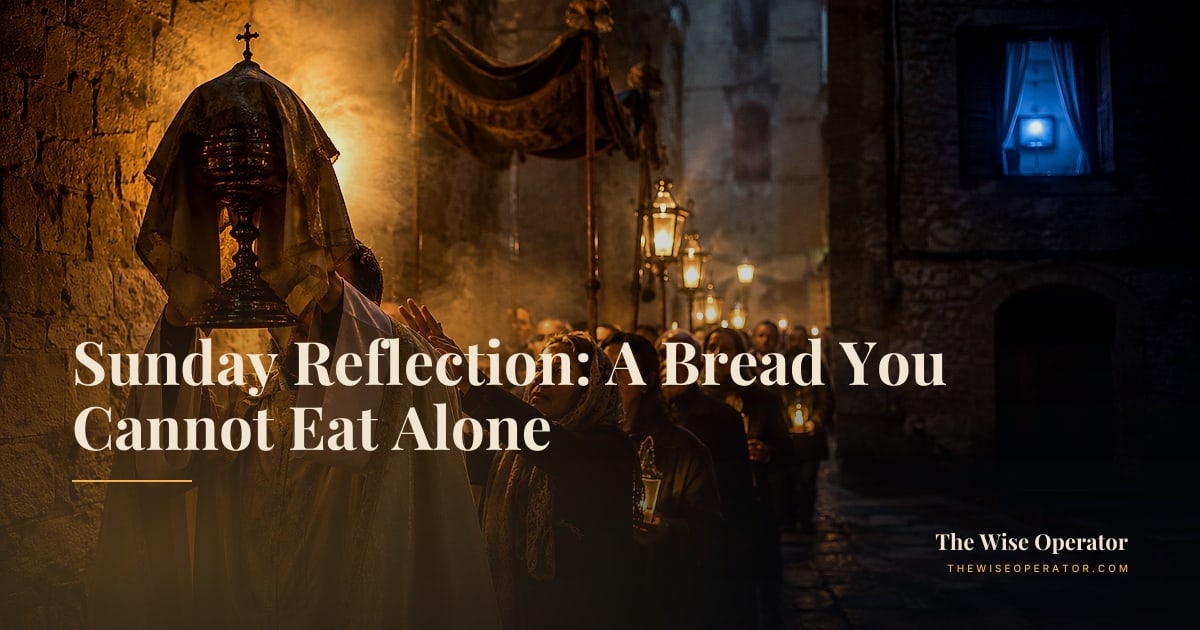
On Corpus Christi the church carries the Eucharist through the streets because the body of Christ is the one meal no private session can serve.
By Scott Krukowski, editor of The Wise Operator
Each Sunday, The Wise Operator steps away from the news to sit with Scripture and ask what ancient wisdom means in the age of AI.
It is Sunday. The week’s noise can wait. Today the church carries the Eucharist out of the tabernacle and through the streets. Corpus Christi. The feast of the body and the blood. The slow announcement that the gift Christ gave on the night before he died was not a memory, not a doctrine, not a private experience anyone can have alone, but a meal the church eats together to become what it eats.
This Week’s Reading: John 6:51-58
“I am the living bread that came down from heaven; whoever eats this bread will live forever; and the bread that I will give is my flesh for the life of the world.” The Jews quarreled among themselves, saying, “How can this man give us his flesh to eat?” Jesus said to them, “Amen, amen, I say to you, unless you eat the flesh of the Son of Man and drink his blood, you do not have life within you. Whoever eats my flesh and drinks my blood has eternal life, and I will raise him on the last day. For my flesh is true food, and my blood is true drink. Whoever eats my flesh and drinks my blood remains in me and I in him. Just as the living Father sent me and I have life because of the Father, so also the one who feeds on me will have life because of me. This is the bread that came down from heaven. Unlike your ancestors who ate and still died, whoever eats this bread will live forever.” John 6:51-58, NABRE
What This Means in the Age of AI
The Bread of Life discourse is the chapter where John shows his hand. Jesus has just multiplied loaves for five thousand people on a hillside. The crowd follows him across the lake the next morning, hungry for another sandwich. He refuses to give it to them. Instead he tells them that the manna their ancestors ate in the desert was the shadow, and he himself is the bread. Most of the crowd walks away. Only the Twelve remain, with Peter speaking the line every operator should memorize for a long career: “Master, to whom shall we go? You have the words of eternal life.”
This is the discourse the church has read out loud on Corpus Christi for centuries because it refuses to let the Eucharist soften into a metaphor. Jesus does not say his teaching is bread. He says his flesh is. The Greek verb in verses 54 to 58 is not the polite phago, “to eat,” but trogo, which means to chew, to gnaw, to munch. John picks the rougher word on purpose. He is telling any reader who would prefer a tidier spiritualization that the church is not allowed to have one.
The new word to learn this week is the one Paul uses in today’s Second Reading, koinonia. The cup of blessing we bless, he writes, is a koinonia in the blood of Christ. The loaf of bread we break is a koinonia in the body of Christ. Communion. Participation. A sharing that makes those who share into one body. Paul is not being figurative. He is naming the thing that happens at the altar, the same thing John names in the Bread of Life discourse: a real meeting in which the giver and the receiver are joined by what is exchanged.
This is the place where modern technology cannot follow. The dominant trajectory in the tools you and I use every day is toward the sealed personal session. A model that knows your preferences. An assistant that runs your calendar. A teacher that adjusts to your pace. None of this is bad, exactly. Most of it is useful. But the metaphysical direction is privacy, isolation, an interior life perfected against any need for another person’s voice. The closer the engineering gets to its goal, the more the operator’s inner life starts to look like a single soul in a quiet room with an oracle.
The Eucharist will never look like that. It cannot be downloaded, cannot be summarized, cannot be cached for later. The Father sends the Son. The Son gives his flesh. The Spirit binds the church around the table. The communicant kneels in a row of other communicants, with strangers on either side, and what feeds them feeds them together. Even the saint receiving the host in a hospital bed is not eating alone, because the priest who brought it walked there from a community, and the bread he carries was consecrated in that community’s prayer. Koinonia does not happen in solitude. It happens because more than one person is in the room.
Carry this into the week. Use the tools. Let them do the work they are good at. But before you let the rhythm of private sessions become the rhythm of your soul, find the room where the bread is broken. Stand in a row. Take the cup. Let the meal that nothing in your stack can synthesize do the work that nothing in your stack was built to do.
The Other Readings
The First Reading (Deuteronomy 8:2-3, 14b-16a) sends Israel back through the memory of the desert, when God let them hunger and then fed them with manna “that he might show you that not by bread alone does one live, but by every word that comes forth from the mouth of the LORD,” the verse Jesus quotes in his own desert testing. The Responsorial Psalm (Psalm 147:12-13, 14-15, 19-20) sings “Praise the Lord, Jerusalem,” because he blesses the city’s children, fills it with the finest wheat, and sends his word swiftly running. The Second Reading (1 Corinthians 10:16-17) is the apostolic root of everything Catholics confess about the Mass: “Because the loaf of bread is one, we, though many, are one body, for we all partake of the one loaf,” the single verse from which the doctrine of koinonia in the Eucharist takes its New Testament root.
A Closing Prayer
Lord Jesus Christ, true bread and true drink, you gave yourself to be eaten so that we would not have to live alone. Keep me from mistaking the comforts of a private screen for the communion you came to make. Bring me back to the table where your body is shared, and let what feeds me there feed me into the rooms where another hungry person is waiting. Amen.
From the Editor
Got a half-formed idea you want to put to work? Let's sharpen it into a build plan.
Prototype Your IdeaA short interview that turns your idea into a structured build plan. Takes about five minutes.