Saturday Tools
Saturday Tools: The Walls Go Up Around the Agent
Anthropic ships dynamic workflows and a real-time Claude Code security plugin, Bluedot routes Apple Watch recordings into Claude. Three tools that put rails around the model.
By Scott Krukowski, editor of The Wise Operator
Each Saturday, The Wise Operator digs into the tools, tutorials, and trending builds worth your weekend. No news, just hands-on discovery.
It’s Saturday. The news can wait. This week three releases land in the same direction. Anthropic shipped dynamic workflows that move the agent’s plan out of the chat window and into a JavaScript orchestration script. Anthropic also pushed a free security plugin that watches Claude Code’s diffs in real time and blocks twenty-five vulnerability patterns before they reach a commit. Bluedot pushed a 2.1 release that records meetings on an Apple Watch and syncs the transcripts to Claude through MCP. Last Saturday the editor disappeared. This Saturday the rails go up around what is left.
Tools Worth Your Weekend
Claude Code Dynamic Workflows
Anthropic shipped dynamic workflows on May 28 alongside Claude Opus 4.8, available in Claude Code v2.1.154 and later. The release reframes how a long task runs. Claude no longer holds the whole plan in its context window. Instead it writes a JavaScript script that orchestrates the work, hands the script to a runtime, and the runtime fans out tens to hundreds of subagents in parallel. A single workflow can coordinate up to one thousand agents, with sixteen running concurrently at any moment, sized to fit an average local machine.
Why it matters: this is the architectural turn the v2.1 line has been building toward for two months. The context window stops being the boss. The script becomes the boss. Intermediate state lives in variables outside the conversation, which means the final answer Claude shows you is verified output and not the exhaust of every speculative step it took to get there. For an operator running a multi-day audit or refactor, that is the difference between paying for a thinking model and paying for a checked one.
Try this: Pick a repo you have been avoiding because the cleanup feels too big. Open a fresh Claude Code session, switch to Opus 4.8, and ask Claude to write a workflow that audits the entire codebase for unused imports, dead routes, and duplicate utility functions, then proposes a single PR that removes them with passing tests. Walk away from the laptop for forty minutes. When you come back, read the run log before you read the diff. The run log is the new artifact you are buying. The diff is the receipt. Available on all paid Claude Code plans, plus Anthropic API, Amazon Bedrock, Vertex AI, and Microsoft Foundry. The non-code-touching version: ask Claude to dynamic-workflow a research sweep across thirty competitor websites and return a single decision memo. Same architecture, different output, no IDE required.
Security Guidance Plugin for Claude Code
At Code w/ Claude London on May 26, Anthropic published a free plugin called Security Guidance to its official Claude Code marketplace. Install it with /plugins from any session. Once active, the plugin sits between Claude’s edit, its diff, and the commit. It uses pattern matching to detect roughly twenty-five vulnerability classes including SQL injection, command injection, cross-site scripting, hardcoded API keys, insecure deserialization, and weak input validation. If Claude tries to ship one, the plugin flags it in-session and asks Claude to fix it before the diff lands. Anthropic’s internal numbers show a thirty to forty percent decrease in security-related PR comments on code written with the plugin enabled.
Why it matters: most “AI security” announcements this year were enterprise dashboards stacked outside the coding loop. This one lives inside the loop, on the local machine, free of charge, with the model and the watcher in the same session. The plugin is not a replacement for code review. It is a replacement for the seventy-five percent of code review that has always been the same five vulnerability patterns the reviewer has already explained twelve times.
Try this: Install the plugin from the marketplace this morning. Then ask Claude to scaffold a small auth flow with a database read, deliberately vague about input sanitization. Watch what the plugin blocks. The blocks themselves are the lesson, because they tell you which vulnerability shapes Claude was about to ship if no one was watching. Code-touching next step: turn on Security Guidance in your active project before your next commit. Non-code-touching next step: forward the list of twenty-five patterns to your team’s IT lead and ask which of them your existing review process actually catches. Free, official Anthropic plugin, requires Claude Code.
Bluedot 2.1 with Apple Watch and Claude MCP
Bluedot, a privacy-first AI notetaker, shipped its 2.1 release on May 27. The new build records directly from an Apple Watch and syncs transcripts to Claude through an MCP server. No laptop in the room. No meeting bot showing up in the calendar invite. A customer call in a hallway, a coffee meeting at a real cafe, an interview on a walk: all of it lands as a structured summary with speaker labels and timestamps, then becomes queryable by Claude or ChatGPT through the MCP connector. Bluedot reported more than ten thousand active customers at launch and double-digit monthly growth, with consumer revenue now matching the older enterprise base.
Why it matters: the chat tab kept assuming the operator was already typing at the desk. The watch breaks that assumption. The MCP layer is the second half of the story. Once your meeting notes are addressable by Claude, you stop pasting transcripts into prompts. You ask Claude what changed across the last three conversations with a single client and let it pull from the indexed corpus. The agent gets a new sense organ, and the operator gets a corpus that no one had to remember to save.
Try this: Install Bluedot on the watch this weekend. Record one fifteen-minute conversation that you would normally never have written down. The neighbor across the fence. A phone call with a parent. A walking review of next week with your spouse. Then open Claude, connect the MCP, and ask it to summarize the three most important things the other person said. The exercise is not about the summary. It is about what you notice when you read your own life back as a transcript you did not have to take. Free tier available, paid plan starts at $18 per month for longer recordings and team features.
What to Watch
Opus 4.8 + Claude Code’s NEW Dynamic Workflows is INSANE (Full Walkthrough) walks through the May 28 release end to end. The host kicks off a dynamic workflow against a real repo, opens the run log alongside the IDE, and shows what the parallel subagents return and how the runtime stitches the verified output back into the main session. Skip the first three minutes of intro. The useful part is the segment where the workflow forks fourteen subagents at once and one of them comes back wrong: watching how the runtime quarantines the failed branch and continues is the operator skill you will actually use this month.
Wisdom Speaks
“He that hath no rule over his own spirit is like a city that is broken down, and without walls.” Proverbs 25:28, KJV
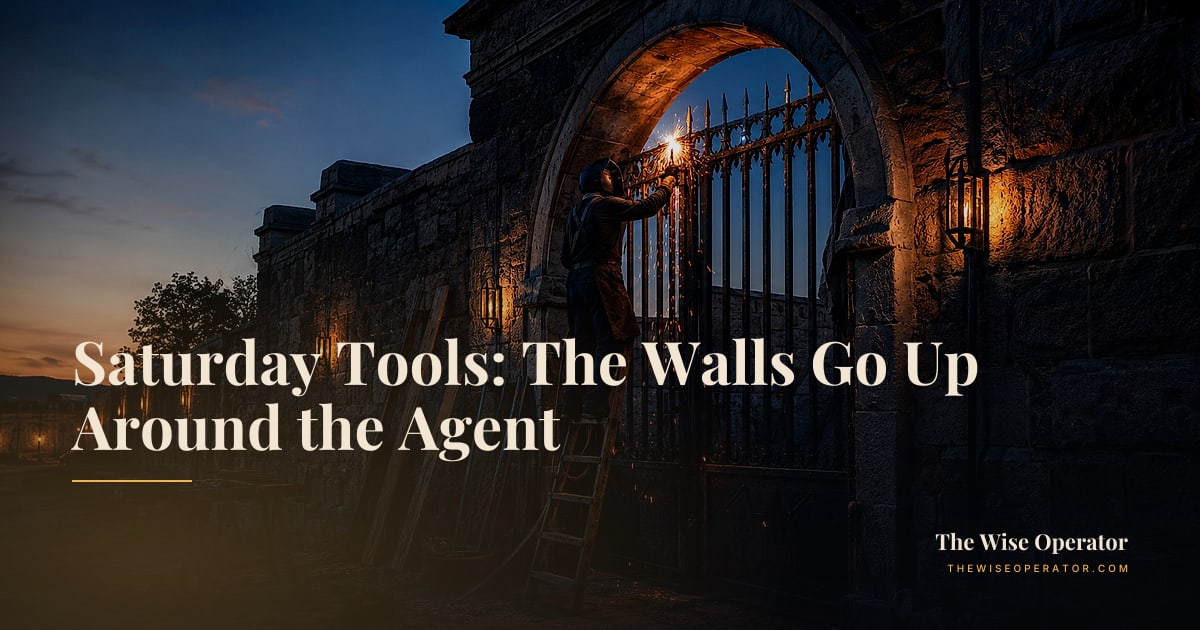
Three tools in one week, each building a wall the agent did not have last weekend. The dynamic workflow walls off the plan from the chat window so Claude cannot drown its own reasoning in tokens. The security plugin walls off the diff from the commit so Claude cannot ship the same five vulnerabilities the room has already corrected. The watch walls off the input from the desk so the conversation can be remembered without being typed. The agent is gaining capacity faster than the operator can intuit, and intuition is the wall that breaks first. The wise builder this week is not the one with the largest model. It is the one with the most considered phragmos around it.
The vineyard parable in Mark 12:1 opens with the owner who “planted a vineyard, and set an hedge about it, and digged a place for the winefat, and built a tower.” The hedge is named before the tower. The boundary precedes the height. Solomon’s proverb is the same idea in shorter form: the city without walls is not less capable, it is more vulnerable. An agent without rails is not faster, it is sooner broken into. The work this weekend is not to use the new tools because they are new. It is to ask which wall each one builds, and whether that wall is the one your project actually needed.
Last Saturday in this seat: Saturday Tools: The Editor Disappears, on the week the editor folded into the agent. This Saturday the rails go up around the agent the editor left behind.
From the Editor
Got a half-formed idea you want to put to work? Let's sharpen it into a build plan.
Prototype Your IdeaA short interview that turns your idea into a structured build plan. Takes about five minutes.