Sunday Reflection
Sunday Reflection: Pentecost and the Voice in Every Language
Acts 2 gives every tongue its own hearing through the Spirit, and translation, however good, is not what makes a sentence carry breath.
By Scott Krukowski, editor of The Wise Operator
Each Sunday, The Wise Operator steps away from the news to sit with Scripture and ask what ancient wisdom means in the age of AI.
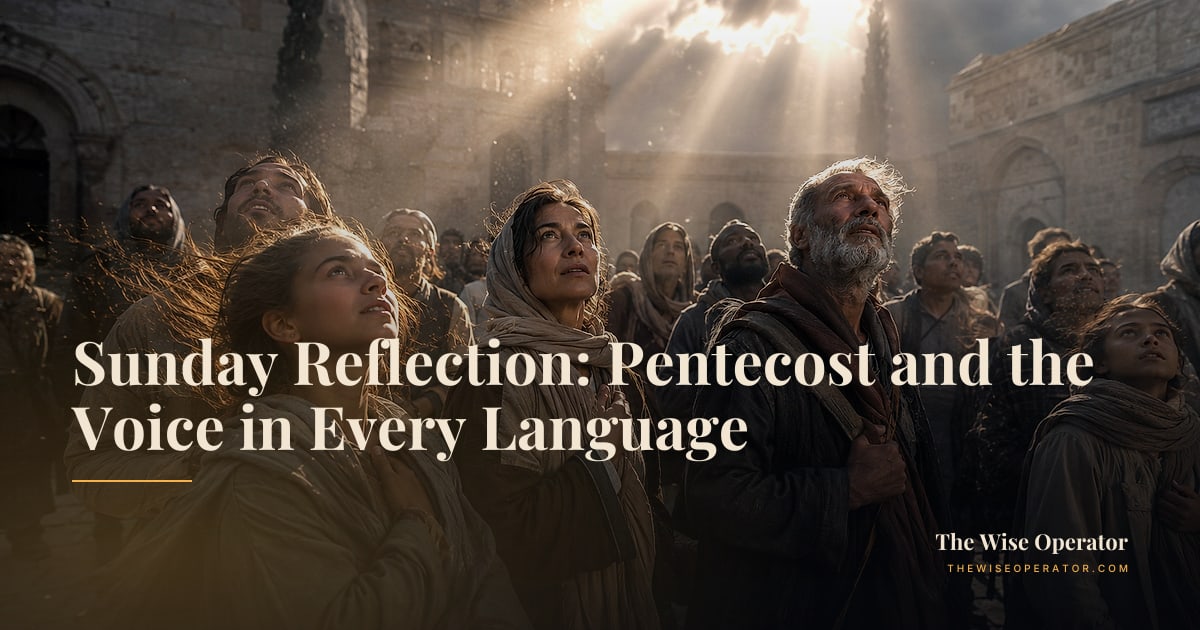
It is Sunday. The week’s noise can wait. Today the church marks the feast that the apostles’ Galilean training never prepared them for, the day the Spirit fell on them in tongues of fire and they began to speak in languages they had never learned. Pentecost. Fifty days after Easter. The birthday of the church.
This Week’s Reading: Acts 2:1-11
“When the time for Pentecost was fulfilled, they were all in one place together. And suddenly there came from the sky a noise like a strong driving wind, and it filled the entire house in which they were. Then there appeared to them tongues as of fire, which parted and came to rest on each one of them. And they were all filled with the holy Spirit and began to speak in different tongues, as the Spirit enabled them to proclaim. Now there were devout Jews from every nation under heaven staying in Jerusalem. At this sound, they gathered in a large crowd, but they were confused because each one heard them speaking in his own language. They were astounded, and in amazement they asked, ‘Are not all these people who are speaking Galileans? Then how does each of us hear them in his own native language? We are Parthians, Medes, and Elamites, inhabitants of Mesopotamia, Judea and Cappadocia, Pontus and Asia, Phrygia and Pamphylia, Egypt and the districts of Libya near Cyrene, as well as travelers from Rome, both Jews and converts to Judaism, Cretans and Arabs, yet we hear them speaking in our own tongues of the mighty acts of God.’” Acts 2:1-11, NABRE
What This Means in the Age of AI
Pentecost is the answer the world had been waiting for since Babel. In Genesis 11, humanity speaks one language and pools its ambition into a tower meant to reach heaven. God scatters them, splinters their speech, sends them to the four winds. Babel ends in confusion and distance and many tongues. For the rest of the Old Testament, the human family is broken into nations that cannot hear each other.
Pentecost reverses Babel, but it does not reverse it the way the tower builders would have wanted. The apostles do not speak one universal language. The crowd does not learn the apostles’ tongue. The miracle moves in the opposite direction: each listener hears the gospel in his own language. Unity without erasure. Diversity gathered around a single proclamation about Christ. The Spirit makes one body of speech without flattening any voice.
We live now in a moment when the technical version of this miracle has arrived. A model can translate a sermon in seconds. A device in the ear can render a conversation into your mother tongue while the other person is still speaking. A non-technical professional can now read papers and contracts and letters in any language without thinking twice. Many people, hearing about Pentecost for the first time in this kind of world, conclude that the transformer architecture behind modern language models simply repeats what the Spirit did once in Jerusalem. The miracle, they say, has been domesticated.
It has not. What we have built is translation, and translation is good. The Spirit’s work at Pentecost was something else. Babel was undone from below by code; Pentecost undid it from above by pneuma, the Greek word for breath and wind and Spirit that runs through the reading. The breath that hovered over the waters in Genesis 1 is the same breath Jesus exhaled on the disciples in the locked upper room in this morning’s Gospel. It is the same breath that filled Galilean fishermen so that Parthians and Medes and Cretans and Romans heard them speak of “the mighty acts of God.” The miracle was not linguistic. It was that the men speaking had nothing of their own to say, and the Spirit said something true through them anyway.
Our tools translate words. The Spirit translates witnesses. A machine can render any sentence in any tongue, and the rendering can be useful and kind. It still cannot give a person something worth saying. That gift comes from somewhere else, and the church remembers today where.
Carry this into the week. The technology around you is real, and it is useful, and a thoughtful operator should learn to use it well. But do not confuse the engineering of language for the gift of voice. Ask, before you speak in any tongue this week, whether the Spirit has given you anything worth saying in it.
The Other Readings
The Responsorial Psalm (Psalm 104:1, 24, 29-30, 31, 34) sings, “Lord, send out your Spirit, and renew the face of the earth,” a hymn of creation that names the Spirit as the breath that calls every living thing into being. Paul’s Second Reading (1 Corinthians 12:3b-7, 12-13) reminds the church at Corinth that the one Spirit gives many different gifts to make one body, and that no one can confess “Jesus is Lord” except by the Holy Spirit. The Gospel (John 20:19-23) shows Jesus appearing to the locked-room disciples on Easter evening, breathing on them, and saying, “Receive the Holy Spirit,” sending them out the same way the Father sent him.
A Closing Prayer
Holy Spirit, breath of the living God, come into the room where I work this week. Loosen what is locked in me. Make me a witness whose words carry something more than my own cleverness, and let whatever tongue I speak in carry a single message about Christ to the one in front of me. Amen.
From the Editor
Got a half-formed idea you want to put to work? Let's sharpen it into a build plan.
Prototype Your IdeaA short interview that turns your idea into a structured build plan. Takes about five minutes.