The Wire
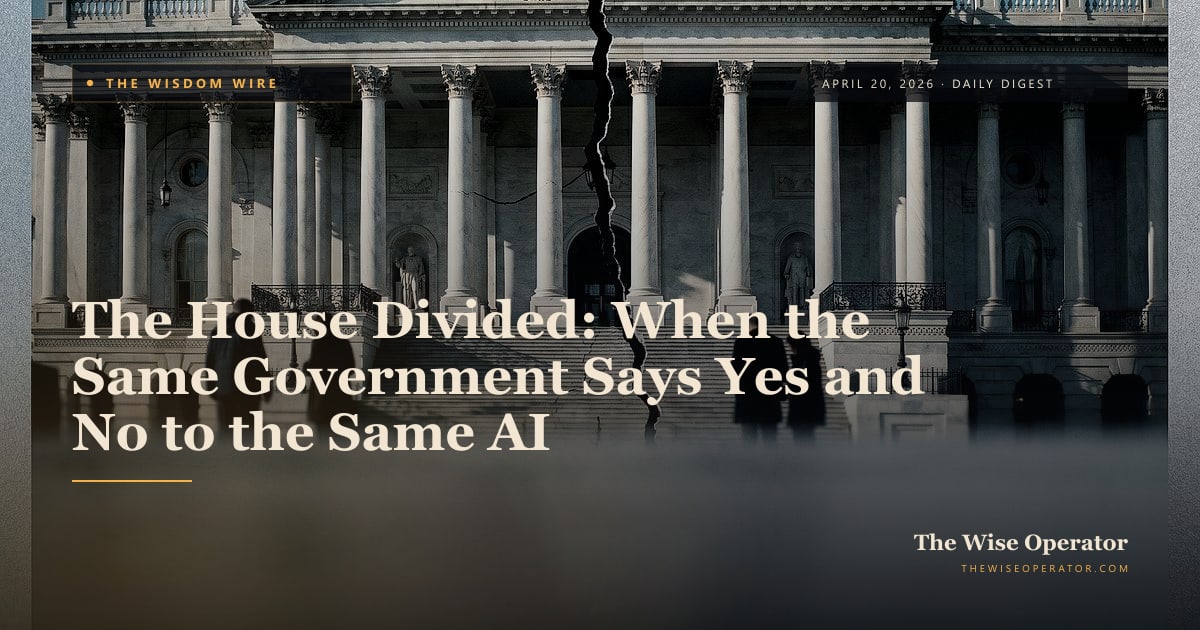
The House Divided: When the Same Government Says Yes and No to the Same AI
The NSA is deploying an AI model that the Pentagon has officially blacklisted. That contradiction is not a bug in the system. It is the system.
By Scott Krukowski, editor of The Wise Operator
The US federal government cannot agree with itself about Anthropic.
The Pentagon has formally designated Anthropic a “supply chain risk,” the kind of label that is supposed to keep a vendor out of government systems. At the same time, the National Security Agency, which operates under the Defense Department’s authority, is actively deploying Anthropic’s restricted Claude Mythos Preview model. Dario Amodei was back at the White House this week for meetings on cybersecurity governance, which means the CEO of the “supply chain risk” company is a recurring guest at 1600 Pennsylvania Avenue.
This is not bureaucratic confusion. This is institutional incoherence at a moment when coherent governance of AI is the one thing everyone says they want.
The deeper issue is that intelligence community demand is simply overriding Pentagon political posturing. The NSA needs what Mythos does. Whether the Defense Department has filed the right paperwork about its supplier relationship with Anthropic is, apparently, a secondary concern. When capability pressure runs headlong into policy restriction, capability wins, especially in national security contexts. That pattern should alarm anyone who believes governance frameworks will hold when the operational stakes get high enough.
This connects to what we covered on April 15, when Anthropic built the largest cyber defense coalition in history. Project Glasswing, the restricted-access cybersecurity deployment that started with US tech consortium partners, is now extending to UK financial institutions. The international expansion of a model that one arm of the US government has blacklisted, while another arm deploys it internally, is a governance story, not just a business one.
Today’s Movers
OpenAI launches GPT-5.4-Cyber, a model explicitly built to find vulnerabilities and analyze malware. Access is restricted to vetted Trusted Access for Cyber participants, a closed program similar to Anthropic’s Glasswing model. This mirrors the architecture of Mythos and signals that both major frontier labs are now building dedicated cyber-permissive models: AI systems deliberately trained to do things that standard safety filters would block. The operator angle: if you work in security, the closed-access model era is beginning. Get on the waitlists now, because the gap between vetted participants and everyone else will widen.
Claude Design launched, and Figma stock fell 7.7% in a single trading session. Anthropic’s new tool ingests a product’s production codebase and generates brand-consistent, code-backed prototypes directly from text prompts. The market read it clearly: this is not a Figma plugin, it is a Figma alternative. The operator angle: if your team is paying for Figma seats primarily for early-stage prototyping, it is worth running a direct comparison this week.
Snap is eliminating 1,000 jobs, 16% of its workforce, and CEO Evan Spiegel cited AI as the reason the company can now operate with “small squads.” The specifics are striking: 65% of new Snap code is now AI-generated, and AI agents identified more than 7,500 bugs. This is not a struggling company cutting to survive. Snap is saving $500M annually while accelerating output. The operator angle: the “small squad” organizational model Spiegel is describing is not a future state, it is a current operating reality at a public company. Your staffing assumptions for AI-adjacent work are likely stale.
Yann LeCun publicly called Dario Amodei’s 50% job elimination forecast “destructive and dangerous,” saying Amodei “knows absolutely nothing” about labor dynamics. The exchange is notable less for who is right and more for what it signals: the most consequential public disagreement in AI right now is not about safety or regulation. It is about whether the people building this technology have any obligation to be honest about its labor consequences. The operator angle: your employees are reading both of them. Have a position.
Germany’s Chancellor Merz argued at Hannover Messe that industrial AI should face lighter EU AI Act regulation than consumer AI. Siemens CEO separately warned that the current regulatory environment is pushing AI capital to the US. The German position represents a significant fracture in European regulatory consensus. One of the EU’s largest economies is now publicly lobbying for a two-tier AI governance structure. The operator angle: if you are building AI products for industrial or enterprise use cases in Europe, this policy fight will directly shape your compliance roadmap. Watch it.
Google is in talks with Marvell to co-develop a memory processing unit and next-generation TPU built for inference. Test production is targeted for 2027, and the explicit goal is reducing dependence on Nvidia and Broadcom. The operator angle: Google building its own inference silicon is a long-term cost signal. If Google gets this right, the price floor for AI inference drops, which compresses margins for infrastructure resellers and benefits everyone paying API bills.
Indian AI startup Sarvam AI is targeting a $350M funding round with Nvidia and Amazon as anchor investors, focusing on multilingual models optimized for Indian languages. The raise reflects a broader pattern: frontier AI is being adapted for non-English linguistic markets with serious capital behind it. The operator angle: if your product serves global or multilingual audiences, the localization layer is no longer a translation problem. It is a model selection problem.
One Tool Worth Knowing
Claude Design (anthropic.com)
Anthropic’s new design tool ingests your production codebase and generates brand-consistent UI prototypes from plain text prompts. The key distinction from existing AI design tools: it reads your actual code, which means outputs are grounded in your real component library and design tokens rather than generated from scratch. Practical note for this week: test it against a real feature you are designing, not a toy example. The gap between impressive demo and useful workflow closes fast when you put genuine constraints on it.
Wisdom Speaks
“If a kingdom be divided against itself, that kingdom cannot stand. And if a house be divided against itself, that house cannot stand.”
Jesus of Nazareth, Mark 3:24-25 (KJV)
Jesus said this while defending his own authority against the accusation that he cast out demons by the power of demons, the charge of self-contradiction used as a weapon to delegitimize. His point was simple: incoherence destroys from within. A house that works against its own foundations does not need an external enemy. It collapses under the weight of its own contradiction.
The NSA deploying what the Pentagon has blacklisted is not primarily a technology story. It is a coherence story. Institutions that cannot hold a consistent position on a critical technology do not lose to adversaries. They lose to themselves. Policy that bends immediately under operational pressure was never really policy. It was theater. The biblical framework for this moment is not judgment. It is diagnosis. When discernment is absent from the center, the periphery improvises. And improvisation at the intelligence-community level is precisely the condition that makes serious governance impossible.
Marcus Aurelius wrote that we have power over our minds, not outside events. The NSA’s deployment of Mythos is an outside event only if you assume the Pentagon’s blacklist represented a genuine decision. If it was a political gesture from the start, the NSA is not violating a house rule. It is simply operating in a house that never agreed on the rules. That is the harder question for any organization watching this: not whether the government is being hypocritical, but whether your own governance around AI represents a real decision or a managed appearance.
The ancient path of wisdom begins with coherence between what an institution says and what it does. A house that cannot maintain that coherence, at whatever scale, cannot stand. Not because enemies bring it down. Because gravity does.
From the Editor
Got a half-formed idea you want to put to work? Let's sharpen it into a build plan.
Prototype Your IdeaA short interview that turns your idea into a structured build plan. Takes about five minutes.