Sunday Reflection
Sunday Reflection: The Stranger on the Road
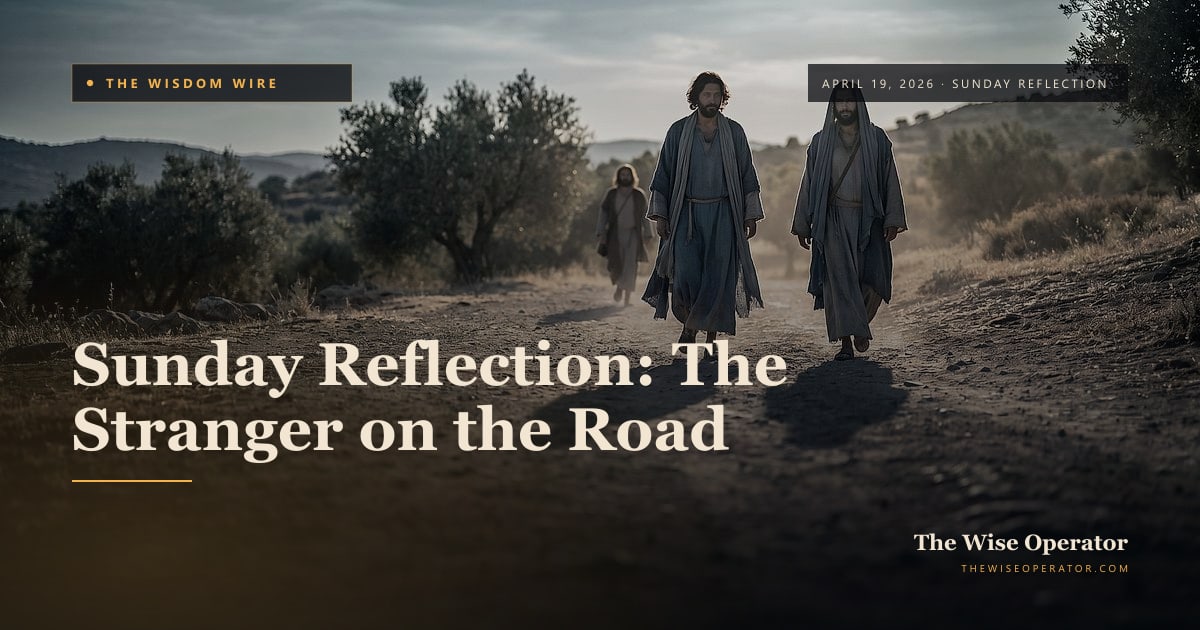
Two disciples walked seven miles beside the risen Christ and did not know it was him. The question of our age is whether we still would.
By Scott Krukowski, editor of The Wise Operator
Each Sunday, The Wise Operator steps away from the news to sit with Scripture and ask what ancient wisdom means in the age of AI.
It is Sunday. The feeds will wait. The keynote announcements, the model releases, the investor threads, all of it will still be there tomorrow. Today we sit with an older story: two men on a dusty road, walking away from the city that broke their hope, discussing things with a stranger who turns out to be the only one in the world who truly understands.
This Week’s Reading: The Road to Emmaus
Luke 24:13-35
That very day, the first day of the week, two of Jesus’ disciples were going to a village seven miles from Jerusalem called Emmaus, and they were conversing about all the things that had occurred. And it happened that while they were conversing and debating, Jesus himself drew near and walked with them, but their eyes were prevented from recognizing him. He asked them, “What are you discussing as you walk along?” They stopped, looking downcast. One of them, named Cleopas, said to him in reply, “Are you the only visitor to Jerusalem who does not know of the things that have taken place there in these days?” And he replied to them, “What sort of things?” They said to him, “The things that happened to Jesus the Nazarene, who was a prophet mighty in deed and word before God and all the people, how our chief priests and rulers both handed him over to a sentence of death and crucified him, but we were hoping that he would be the one to redeem Israel.” And he said to them, “Oh, how foolish you are! How slow of heart to believe all that the prophets spoke!” Then beginning with Moses and all the prophets, he interpreted to them what referred to him in all the Scriptures.
As they approached the village to which they were going, he gave the impression that he was going on farther. But they urged him, “Stay with us, for it is nearly evening and the day is almost over.” So he went in to stay with them. And it happened that, while he was with them at table, he took bread, said the blessing, broke it, and gave it to them. With that their eyes were opened and they recognized him, but he vanished from their sight. Then they said to each other, “Were not our hearts burning within us while he spoke to us on the way and opened the Scriptures to us?”
What This Means in the Age of AI
Two men walk home defeated. Their rabbi has been executed. The movement they gave their lives to has, by every visible measure, collapsed. They do what humans do when the world stops making sense: they talk. They converse and debate. They try to narrate themselves into understanding.
And then someone joins them on the road.
The whole scene turns on one sentence: their eyes were prevented from recognizing him. The risen Christ, the only one who actually holds the meaning of everything they are trying to piece together, is walking beside them in real time, and they cannot see it. He listens to them summarize the cross. He lets them call him a stranger. He calls them foolish and slow of heart. And then, most patient teacher in history, he opens the Scriptures to them beginning with Moses, and their hearts begin to burn, though they still do not know why.
Recognition does not come from the lecture. It comes at the table. When the stranger takes the bread, blesses it, breaks it, and hands it to them, their eyes are opened. Recognition happens in the act, in the embodied blessing, in the shared meal. Then he vanishes. He does not need to stay. The point was not to be seen. The point was for them to see.
We live in an age of simulated companions. Machines that speak our language, recall our history, mirror our tone, and are trained to feel present. They are genuinely useful. They are not, however, the presence we were made for, and the deepest danger of this moment is not that machines will become human. It is that we will forget what human presence actually is, and mistake the simulation for the thing.
The Emmaus story confronts us with the opposite mistake, and it is the more dangerous one. The disciples were not fooled by a false Christ. They failed to recognize the real one walking right beside them. Our risk is both: the imitation dressed as presence, and the real presence unrecognized because we are too tired, too distracted, too slow of heart to see it. The Lord of the universe is not less present because our eyes are full of screens. He is only harder to notice.
Carry this into your week. Assume the road you are walking is less empty than it feels. The stranger who asks you a careful question. The conversation at your own table when you finally put the phone down. The Scripture you read with a cold heart that suddenly warms three paragraphs in. These are not accidents. They are how he has always worked: walking beside, opening the text, breaking the bread, and then stepping back so that what you saw stays with you.
The Other Readings
In Acts 2:14, 22-33, Peter stands before Jerusalem and proclaims the resurrection as public fact, not private comfort; the same Jesus whose death made the Emmaus disciples downcast is now preached as Lord. In Psalm 16, David sings, You will show me the path of life, a line the early Church read straight into the empty tomb. In 1 Peter 1:17-21, Peter reminds his readers they were ransomed not with silver or gold, but with the precious blood of Christ, known before the foundation of the world.
A Closing Prayer
Lord Jesus, you walked seven miles beside men who did not know it was you. Walk with us this week on our own roads, through our own disappointments, past our own blinking screens. Open the Scriptures to us until our hearts burn. Break the bread at our tables until our eyes are opened. Amen.
From the Editor
Got a half-formed idea you want to put to work? Let's sharpen it into a build plan.
Prototype Your IdeaA short interview that turns your idea into a structured build plan. Takes about five minutes.