The Wire
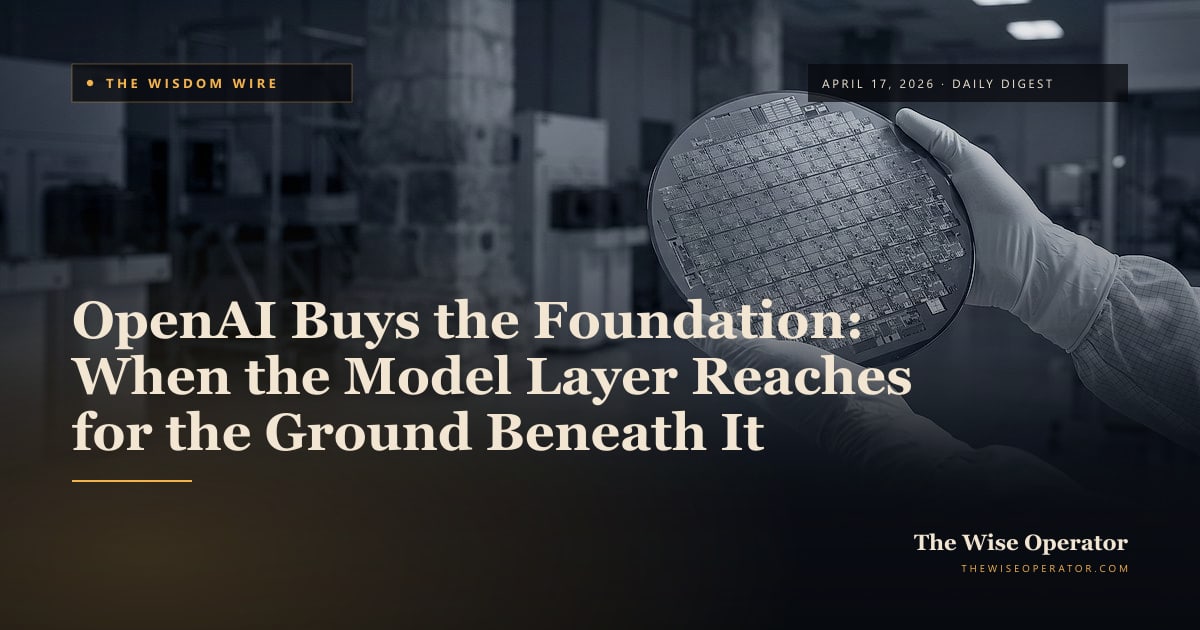
OpenAI Buys the Foundation: When the Model Layer Reaches for the Ground Beneath It
OpenAI just committed $20 billion to own the chips it runs on. Uzziah built towers too, right before he reached into a layer that was not his to hold.
By Scott Krukowski, editor of The Wise Operator
OpenAI agreed to pay more than $20 billion for server capacity powered by Cerebras chips (Reuters), double the figure previously reported, and will receive an equity stake in the chip startup in return. It is the largest single infrastructure commitment any AI company has made. The deal is not just a procurement agreement. It is a declaration of architecture.
For years, the hyperscaler model was simple: rent compute, build models, sell access. OpenAI is now buying the picks and shovels. After the CoreWeave deal we covered on April 10 and a string of infrastructure moves reported since, Cerebras makes the pattern legible. OpenAI does not want to depend on Nvidia. It does not want to depend on Microsoft. It wants to own the layer beneath its models the same way it owns the models themselves.
The operator question nobody is asking: if OpenAI becomes the infrastructure, what does that mean for every startup that built on top of OpenAI’s API assuming it was a neutral utility? A vendor that owns its own chips, its own data centers, and its own distribution is not a utility. It is a platform with leverage.
The context window gets bigger. The supply chain gets tighter. The moat gets wider. Watch this space.
Today’s Movers
Claude Mythos Triggers Emergency Meetings Among Finance Ministers The model Anthropic has not publicly released is now moving central bankers. Finance ministers, Bank of England Governor Andrew Bailey, and Barclays CEO CS Venkatakrishnan told the BBC that Mythos has prompted crisis-level discussions about threats to financial system security. The UK AI Security Institute confirmed Mythos can exploit systems with weak security posture. The US Treasury has urged major banks to stress-test ahead of any public release. We first flagged Mythos on April 15 when Anthropic revealed it existed. The gap between “we have a model” and “regulators are holding emergency meetings about it” closed in 48 hours. If your product touches financial data, authentication, or any system with meaningful security posture, the stress-test conversation is no longer hypothetical.
Anthropic Ships Claude Opus 4.7
Anthropic released Claude Opus 4.7 with 87.6% on SWE-bench Verified, 94.2% on GPQA, a 1M-token context window, and new xhigh effort and task budget controls for agentic work (NewsBytesApp). Notably, Anthropic stated this model is “less broadly capable” than Claude Mythos Preview, which remains restricted. The task budget controls are the detail worth watching: they let operators cap how much compute an agent spends per task, which is the missing lever in most agentic deployments. The token-budget controls alone justify evaluating Opus 4.7 for any agentic workflow where runaway inference costs have been a blocker.
OpenAI Launches GPT-Rosalind for Life Sciences OpenAI released GPT-Rosalind, a reasoning model built for life sciences and named after Rosalind Franklin, available in ChatGPT, Codex, and the API for qualified customers (Reuters). It connects to 50+ scientific tools and data sources. Launch partners include Amgen, Moderna, and Thermo Fisher Scientific. OpenAI’s vertical-model strategy is now consistent: Rosalind for life sciences follows the pattern of purpose-built models replacing generic ones in regulated, data-rich domains. If you serve healthcare or pharmaceutical clients, evaluate before building your own retrieval layer.
Salesforce Launches Headless 360 at TDX Salesforce unveiled Headless 360, exposing its entire platform including Customer 360, Data Cloud, and Agentforce as infrastructure for AI agents via API, shipping with 60+ new MCP tools (Agile Brand Guide). This is Salesforce’s biggest architecture change in 27 years. The company is not building a better CRM. It is repositioning itself as an agentic backend for enterprise systems, which is a fundamentally different product and revenue model. Every enterprise integration you built assuming Salesforce was UI-forward may need to be reconsidered.
Alibaba Open-Sources Qwen3.6-35B-A3B The Qwen team released a Mixture-of-Experts coding model that activates only 3B of its 35B parameters per query yet outperforms dense models ten times its size on coding benchmarks (ByteIota). It is designed for agentic-coding workflows and released openly. This is the efficiency argument made concrete: sparse activation means you get large-model quality at small-model inference cost. For teams running self-hosted models or managing inference cost closely, benchmark it before your next infrastructure decision.
Sequoia Closes $7 Billion AI Fund Sequoia raised approximately $7 billion for late-stage AI startups (NewsBytesApp), following a Q1 2026 in which global venture investment exceeded $300 billion for the first time. OpenAI, Anthropic, xAI, and Waymo absorbed 65% of all global venture dollars. The concentration is the signal. Capital is not flowing broadly into AI; it is flowing to a small set of foundational players and the infrastructure beneath them. This is not a rising-tide market. Build a defensible position or build something the giants cannot easily absorb.
One Tool Worth Knowing
Claude Opus 4.7 is Anthropic’s most capable publicly available model as of today. The benchmarks are strong (87.6% SWE-bench Verified, 94.2% GPQA), but the operator-relevant features are the xhigh effort level and task budget controls. These give you explicit levers on how hard the model works and how much compute it spends per task. Combined with the 1M-token context window, Opus 4.7 is the current ceiling for long-context agentic work at production quality. If you are building workflows where cost control and reasoning depth are in tension, start here.
Wisdom Speaks
“But when he was strong, his heart was lifted up to his destruction: for he transgressed against the LORD his God, and went into the temple of the LORD to burn incense upon the altar of incense.” — 2 Chronicles 26:16 (KJV)
Uzziah was not weak when he fell. He was at the peak of his reign. He had built towers in Jerusalem and in the wilderness. He had engineered siege machines. He had organized a standing army. Scripture says he was “marvelously helped, till he was strong.” Strength was not his problem. Strength was the condition that made his error possible.
His sin was not ambition. He had always been ambitious. His sin was crossing a layer. The altar of incense was the priests’ domain. Not because Uzziah was unworthy as a man, but because the structure existed for a reason, and the structure preceded him. He walked in with a censer in his hand and eighty priests followed him in to resist him. He left with leprosy on his forehead and died in isolation, cut off from the house of the LORD.
The pattern across today’s news is the same motion at different scales. OpenAI reaches into the chip layer. Claude Mythos reaches into the security layer of the global financial system. Salesforce reaches into the infrastructure layer beneath its own product. Each of these moves has logic. Each operator believes the rules that constrained the previous generation do not apply to the strong. They may be right about the short term. Uzziah was also right, briefly. The priests could not stop him from entering. They could only witness what happened when he did.
Stewardship is the discipline of knowing which layer is yours to hold and which one belongs to someone else. Not because you could not reach it, but because reaching for it anyway is exactly when the thing you built begins to work against you.
From the Editor
Got a half-formed idea you want to put to work? Let's sharpen it into a build plan.
Prototype Your IdeaA short interview that turns your idea into a structured build plan. Takes about five minutes.